
Nitrofurantoin and Hemolytic Anemia: What You Need to Know About G6PD Deficiency Risk
G6PD Deficiency Risk Assessment Tool
This tool helps you assess your risk of having G6PD deficiency based on your ancestry and health history. If you're at risk, please discuss G6PD testing with your doctor before taking nitrofurantoin for a UTI.
When you get a urinary tract infection (UTI), your doctor might reach for nitrofurantoin. It’s cheap, effective, and commonly prescribed-especially for simple infections. But here’s something most people don’t know: if you have G6PD deficiency, this antibiotic can trigger a dangerous, sometimes life-threatening reaction called hemolytic anemia. And if you’ve never been tested, you might not even know you’re at risk.
What is nitrofurantoin, and why is it so common?
Nitrofurantoin has been around since the 1940s. It’s not flashy, but it works well against the most common bacteria that cause UTIs, especially Escherichia coli. Unlike some other antibiotics, it stays mostly in the urine, which means fewer side effects in the rest of your body. That’s why it’s still one of the top three go-to drugs for uncomplicated UTIs in the U.S., with over 5.5 million prescriptions filled every year.
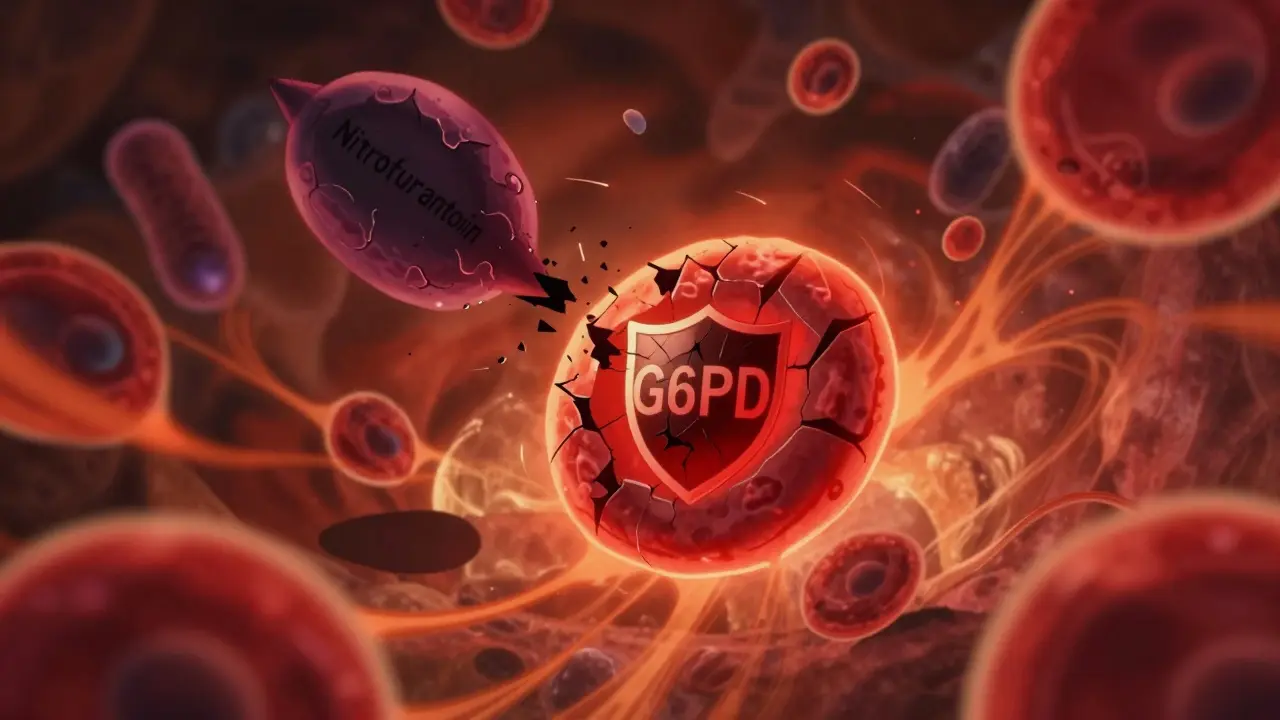
But here’s the catch: nitrofurantoin doesn’t just attack bacteria. In certain people, it turns into a chemical that rips apart red blood cells. This isn’t a rare side effect-it’s a well-documented, predictable reaction in people with a specific genetic condition called glucose-6-phosphate dehydrogenase (G6PD) deficiency.
What is G6PD deficiency?
G6PD deficiency is a genetic condition that affects how your red blood cells handle stress. Normally, your body uses an enzyme called G6PD to protect red blood cells from damage caused by oxidation. Think of it like a shield. When you take certain drugs, eat certain foods, or get sick, your body produces reactive chemicals that can harm these cells. G6PD helps neutralize them.
If you’re missing this enzyme-or have very little of it-your red blood cells are defenseless. Nitrofurantoin pushes them into overdrive. The drug creates oxidative stress in the urine, and when it gets absorbed into your bloodstream, it attacks those unprotected cells. The result? Hemolysis: your red blood cells burst open, spilling their contents into your blood.
This isn’t theoretical. A 2022 review of medical literature found 42 confirmed cases of hemolytic anemia directly linked to nitrofurantoin in G6PD-deficient patients. Ten of those cases ended in death. And the majority of these patients had never been tested before taking the drug.
Who’s at risk?
G6PD deficiency isn’t rare. The World Health Organization estimates around 400 million people worldwide have it. But it’s not evenly spread. In some populations, it’s very common:
- 10-14% of people of African descent
- 4-7% of people from the Mediterranean or Middle East
- 2-5% of people from Southeast Asia
That means if you’re from Nigeria, Somalia, Sardinia, Thailand, or Cambodia, your odds of having this condition are much higher than someone from Sweden or Finland. And because it’s inherited on the X chromosome, men are more likely to show symptoms than women-but women can still be carriers and affected.
And it’s not just adults. Infants exposed to nitrofurantoin through breast milk have had hemolytic episodes. Pregnant women with undiagnosed G6PD deficiency have also been hospitalized after taking the drug.
What happens when nitrofurantoin triggers hemolysis?
Symptoms don’t wait. They usually show up within 24 to 72 hours of starting the drug. You might feel:
- Fever
- Dark urine (like tea or cola)
- Yellowing of the skin or eyes (jaundice)
- Extreme fatigue
- Shortness of breath
- Rapid heartbeat
- Back or abdominal pain
Lab tests will show a sharp drop in hemoglobin, rising bilirubin, and high levels of LDH-all signs that red blood cells are being destroyed. Haptoglobin, a protein that binds to free hemoglobin, will crash. Reticulocyte count will spike as your bone marrow scrambles to replace the lost cells.
In one documented case, a patient’s hemoglobin fell from 14 g/dL to 7.8 g/dL in under 72 hours. He was hospitalized with confusion, vomiting, and low blood pressure. He recovered fully after stopping the drug and getting IV fluids-but he nearly needed a transfusion.
Why isn’t everyone tested before taking nitrofurantoin?
Here’s the frustrating part: the FDA label for nitrofurantoin clearly warns about G6PD deficiency. But it doesn’t require testing before prescribing. The same goes for most clinics and pharmacies. A 2022 survey of 350 U.S. primary care doctors found only 32% routinely check G6PD status before prescribing nitrofurantoin.
Why? Cost. A G6PD test costs $35-$50. A hospitalization for hemolytic anemia? $8,500 to $12,000. But most doctors don’t think about the long-term cost-they think about the immediate need to treat the UTI.
And there’s another problem: many people with G6PD deficiency never know they have it. Half to 60% of affected individuals go undiagnosed until they’re hit with a drug like nitrofurantoin, or they eat fava beans, or get a severe infection.
What should you do instead?
If you’re in a high-risk group-or if you’ve ever had unexplained anemia, jaundice, or dark urine after taking medication-ask for a G6PD test before accepting nitrofurantoin. It’s a simple blood test. No fasting. No needles. Just a finger prick or a vial of blood.
And if you’re diagnosed with G6PD deficiency? There are safe alternatives:
- Fosfomycin (Monurol): A single-dose oral antibiotic with no known risk of hemolysis.
- Cephalexin: A first-generation cephalosporin that’s safe in most G6PD-deficient patients.
- Amoxicillin-clavulanate: Often used for UTIs and doesn’t trigger oxidative stress.
- Trimethoprim-sulfamethoxazole (TMP-SMX): Still widely used, but has its own risks (allergies, kidney issues) and higher resistance rates.
According to the American Society of Hematology and the Clinical Pharmacogenetics Implementation Consortium (CPIC), nitrofurantoin should be avoided entirely in people with known G6PD deficiency. Fosfomycin is often the best first choice because it’s single-dose, low-risk, and effective.

The bigger picture: Why this matters
Nitrofurantoin isn’t going away. It’s too cheap, too effective, and too widely used. But we’re starting to see change. The European Medicines Agency updated its warnings in 2021. The NIH is running a trial to see if universal G6PD testing before nitrofurantoin use saves money and lives. Point-of-care tests are being developed that could give results in under 10 minutes during a clinic visit.
Right now, though, the system is still broken. Doctors prescribe. Patients take. And too often, someone gets sick because no one asked the right question: Have you ever had a bad reaction to medication? Do you know your ancestry? Have you been tested?
If you’re a woman of African, Mediterranean, or Southeast Asian descent, and you’ve ever had a UTI treated with nitrofurantoin, think back. Did you feel unusually tired? Did your urine turn dark? Did you get sick right after starting the pills? You might have had a warning sign you didn’t recognize.
What to ask your doctor
If you’re being prescribed nitrofurantoin, ask these three questions:
- Do I have any risk factors for G6PD deficiency based on my ancestry or past reactions?
- Can we do a quick G6PD test before I start this medication?
- Is there a safer alternative that works just as well for my type of infection?
You’re not being difficult. You’re being smart. And you might be saving your life.
Bottom line
Nitrofurantoin is a good drug-for the right person. But for someone with G6PD deficiency, it’s a ticking time bomb. The science is clear. The risks are real. And the solution? Simple testing and smarter prescribing.
Don’t assume you’re safe just because you’ve taken antibiotics before. G6PD deficiency doesn’t always show itself. But when it does, it hits fast. And it doesn’t care if you’re young, healthy, or never had a problem before.
Ask for the test. Know your risk. Choose safety over convenience. Because when it comes to your blood, there’s no room for guesswork.
Can nitrofurantoin cause hemolytic anemia in people without G6PD deficiency?
Rarely. While nitrofurantoin’s main risk is in G6PD-deficient individuals, there have been isolated reports of hemolytic anemia in people without the deficiency, usually due to high doses, prolonged use, or underlying conditions like kidney disease. But these cases are extremely uncommon. The overwhelming majority of drug-induced hemolysis from nitrofurantoin occurs in those with G6PD deficiency.
Is G6PD testing covered by insurance?
Yes, in most cases. In the U.S., Medicare and most private insurers cover G6PD testing when ordered by a physician for clinical reasons, such as before prescribing nitrofurantoin. The test typically costs $35-$50 out-of-pocket if not covered, but many labs offer discounts for self-pay patients. Always check with your provider beforehand.
Can I take nitrofurantoin if I have G6PD deficiency but never had a reaction before?
No. G6PD deficiency doesn’t always cause symptoms unless triggered by a stressor like a drug, infection, or certain foods. Just because you took nitrofurantoin before without issues doesn’t mean you’re safe. Your enzyme levels can change over time, or the dose might be higher this time. The medical consensus is clear: avoid nitrofurantoin entirely if you have G6PD deficiency, regardless of past history.
Are there any signs I might have G6PD deficiency without knowing?
Yes. If you’ve ever had unexplained jaundice as a newborn, dark urine after taking antibiotics or eating fava beans, or severe fatigue after an infection, you might be G6PD deficient. People from high-prevalence regions (Africa, Mediterranean, Southeast Asia) with a family history of anemia or jaundice should consider testing-even if they’ve never had symptoms.
What should I do if I accidentally took nitrofurantoin and have G6PD deficiency?
Stop the drug immediately. Drink plenty of water. Contact your doctor or go to urgent care. Symptoms like dark urine, fatigue, or yellowing skin can appear within hours. Most people recover fully with supportive care-fluids and monitoring-but early action prevents complications like kidney damage or severe anemia. Don’t wait for symptoms to get worse.
Look, I get it. Nitrofurantoin is cheap. But so is a hospital bill. I’ve seen three patients in my ER alone this year with dark urine and jaundice after this drug. One was a 28-year-old woman who thought she was ‘just getting over a cold.’ She didn’t know her dad was from Nigeria. No one asked. No one tested. We’re not being proactive-we’re just lucky it didn’t kill someone.
Thank you for this incredibly thorough and compassionate breakdown. As a healthcare provider, I’ve seen too many patients suffer avoidable harm because of assumptions. The fact that G6PD testing is covered by insurance in most cases should make this a no-brainer. We owe it to our patients to ask the simple questions-especially when the stakes are this high. Let’s normalize screening before prescribing.
Oh wow. So the FDA doesn’t require testing... but the pharmaceutical companies? They love nitrofurantoin. $50 test vs $10k hospital stay? That’s not negligence. That’s a business model. And don’t even get me started on how many people in the ‘high-risk’ groups are just told ‘it’s probably allergies’ when they get sick. This is systemic. It’s not an accident. It’s designed. And now we’re all just supposed to be grateful for a blog post? 🤡
I had a UTI last year. Took nitrofurantoin. Felt like death for three days. Dark urine. Couldn’t get out of bed. Thought I was dying. Went to urgent care and they said ‘it’s just the side effects.’ I cried. I was so scared. I never connected it to my heritage. My mom’s side is from the Philippines. I didn’t know that meant anything. Now I’m terrified to take any antibiotic. What if I get another UTI? What if I die next time? Why didn’t anyone warn me?
I’m a nurse. I’ve seen this happen. A woman, 34, Nigerian descent, took nitrofurantoin for a UTI. Came back in 48 hours with hemoglobin at 6.2. She was pale. Pulse 130. Said she’d never been sick like this. Never tested. Never knew. We gave her fluids, held her hand. She’s fine now. But she’s terrified. And honestly? I don’t blame her. This should be standard. Like asking about allergies before penicillin. Why isn’t it?
You know what’s REALLY scary? That this isn’t even on the damn prescription label in big red letters. It’s buried in fine print. Like they want people to miss it. And let’s be real-most doctors don’t even read the full label. They just copy-paste the script. This is how people die. Not from bad luck. From laziness. From arrogance. From thinking ‘it’s not my problem.’ You don’t get to be a doctor and not know this. You’re not saving lives-you’re just pushing pills.
I’m from Australia, and I’ve got a cousin in Nigeria who nearly died from this. He’s 24, healthy, never had a problem-until he took nitrofurantoin for a UTI after a trip. He ended up in ICU. Turns out his uncle had G6PD deficiency. No one told him. No one tested him. We’re lucky he survived. I’ve been pushing everyone in my family to get tested. It’s a finger prick. Five minutes. Could save your life. Why isn’t this common knowledge? It should be taught in high school biology.
I’ve got G6PD deficiency. Never knew. Took nitrofurantoin once. Felt like I was being slowly poisoned. Dark pee. Headache. Couldn’t breathe. Thought I was dying. Went to the doc. They said ‘it’s probably dehydration.’ I didn’t push back. I was too tired. Now I know. I’m 32. I’ve had 3 UTIs since. Always ask for fosfomycin. Always. I’ve started telling every woman I know who’s from Asia or Africa: ‘if you get a UTI, ask for fosfomycin. Don’t let them give you nitrofurantoin.’ It’s not a request. It’s a survival tactic.
This is why your culture is broken. You think medicine is about science? No. It’s about profit. You let people die because they’re poor, or brown, or from ‘the wrong side of the world.’ You don’t test because it costs money. You don’t care because they’re not ‘your people.’ And now you write long articles like you’re the hero? Wake up. This isn’t awareness. It’s guilt porn. You’re not helping. You’re just feeling better about yourself.
Let’s zoom out. This isn’t just about nitrofurantoin. It’s about the entire paradigm of Western medicine’s blind spot: genetic risk stratification. We test for BRCA. We test for sickle cell. We test for cystic fibrosis. But G6PD? It’s an afterthought. Why? Because it’s ‘common in developing nations.’ That’s not science. That’s colonialism dressed up as clinical practice. The system doesn’t fail because of ignorance. It fails because it was designed to ignore certain populations. And until we fix that, we’re just rearranging deck chairs on the Titanic.
Fosfomycin is the real MVP here. Single dose. Zero interaction with G6PD. Works great for uncomplicated UTIs. I’ve been pushing it in my clinic for a year. Patients love it. Docs? Not so much. ‘It’s more expensive.’ Bro, it’s $40. A hospital stay is $10K. Math isn’t hard. Also, if you’re from Southeast Asia or Africa and you’ve ever had jaundice as a kid? Get tested. Seriously. Do it. It’s one of those things that changes everything.
I’m from Ghana. My dad had G6PD deficiency. He never told us. He took penicillin once, got sick, and just assumed he was allergic. We didn’t know. I got my first UTI last year. Took nitrofurantoin. Felt awful. Thought I was allergic. Went to the doctor. They asked about my heritage. I said yes. They did the test. Turned out I had it too. Now I’m telling everyone I know. This isn’t just a medical issue. It’s cultural. We need to talk about this at family gatherings. Not just in hospitals.
I’ve been in med school for 5 years. We covered G6PD in one 20-minute lecture. No case studies. No simulation. No test. Just a slide. And yet, we’re expected to prescribe antibiotics. That’s not education. That’s a liability waiting to happen. I’m now campaigning for mandatory G6PD screening in our clinical rotations. If you’re prescribing nitrofurantoin without testing, you’re not a doctor-you’re a roulette wheel. And I’m tired of seeing patients lose.