
Future of Global Generic Markets: Predictions and Trends 2025-2030
The global generic drug market isn’t just about cheap pills. It’s the backbone of healthcare for billions of people who can’t afford brand-name drugs. By 2028, this market is expected to hit over $650 billion, and by 2030, it’ll still be the main way people get life-saving medicines - even as the landscape shifts dramatically. Generic drugs aren’t disappearing. They’re evolving. And the companies that survive will be the ones that adapt faster than anyone else.
Why generics still dominate - and how they’re changing
Today, nearly 9 out of 10 prescriptions in the U.S. are filled with generic drugs. In Europe, it’s 70% or higher in countries like Germany. But here’s the twist: while generics make up 90% of prescriptions, they account for only 23% of total drug spending. Why? Because they’re cheap. A generic version of a drug can cost 80-85% less than the brand-name version. That’s not a small discount - it’s what keeps hospitals, governments, and families from going broke.
But the old model is cracking. The easiest targets - common pills for high blood pressure, diabetes, or cholesterol - are already saturated. The next wave of growth isn’t in aspirin or metformin. It’s in biosimilars. These are generic versions of complex biologic drugs, like those used to treat cancer, rheumatoid arthritis, or severe diabetes. Unlike traditional generics, which are chemically identical to their branded counterparts, biosimilars are made from living cells. They’re harder to copy. They cost $100-250 million to develop, compared to $1-5 million for a regular generic. And they’re priced only 15-30% below the original, not 80%.
That’s a game-changer. It means generic manufacturers can no longer compete on price alone. They have to compete on capability. If you don’t have the labs, the expertise, or the regulatory know-how to make biosimilars, you’re falling behind.
The rise of pharmerging markets
The biggest growth isn’t happening in the U.S. or Germany. It’s in India, China, Brazil, Turkey, and Saudi Arabia. These are the "pharmerging" markets - countries where healthcare systems are expanding, insurance is rolling out, and governments are pushing for affordable medicines.
India alone produces over 60,000 generic medicines and supplies 20% of the world’s generic drug volume by volume. China makes about 40% of the global supply of active pharmaceutical ingredients (APIs), the raw chemical building blocks of drugs. Together, they control roughly 35% of global manufacturing capacity. And they’re not just making pills for export - they’re building domestic supply chains.
Saudi Arabia’s Vision 2030 is pushing for local drug production. Egypt now requires 50% of essential medicines to be made locally by 2025. India’s $1.34 billion Production Linked Incentive (PLI) scheme is helping manufacturers build new factories. These aren’t just policies - they’re strategic moves to reduce dependence on foreign suppliers.
And it’s working. Pharmerging markets are expected to add $140 billion in drug spending by 2025. That’s more than half of the entire global growth in medicine spending over the last five years. If you’re a generic manufacturer and you’re not focused on these regions, you’re missing the future.
The quality crisis no one talks about
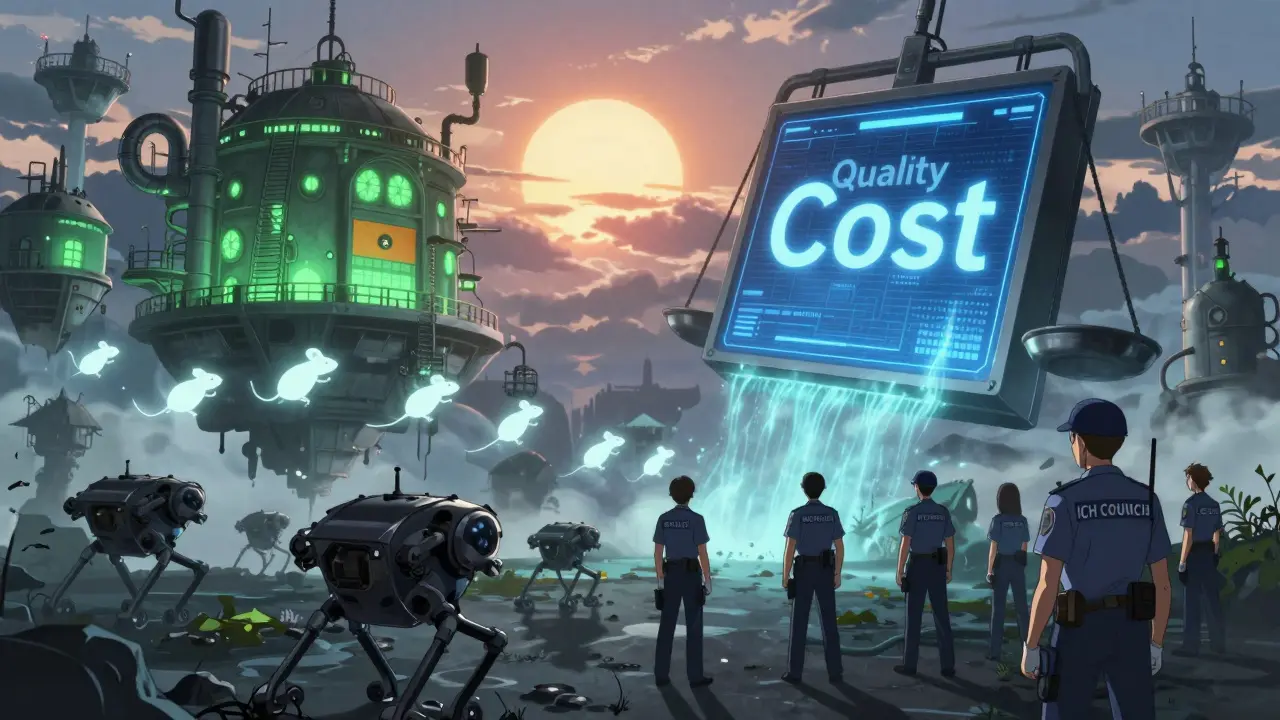
There’s a dark side to all this growth. In 2023, the U.S. FDA issued 187 warning letters to foreign generic drug manufacturers. Forty percent of those were tied to quality control failures - dirty facilities, falsified data, poor storage. One factory in India was shut down after inspectors found rats in the drug-making area. Another in China was caught shipping expired APIs as fresh.
This isn’t just bad PR. It’s a systemic risk. The world relies on these factories. If a batch of blood pressure pills from a poorly regulated plant fails, people die. And the FDA can’t inspect every facility. There are over 78 different regulatory systems worldwide, and not all of them have the power or resources to enforce standards.
That’s why the push for harmonization matters. The International Council for Harmonisation (ICH) is gaining momentum. In 2024 alone, 15 more countries adopted its guidelines. That means factories in Brazil, Nigeria, or Indonesia will have to meet the same quality rules as those in the U.S. or EU. It’s slow, but it’s the only way to keep the global supply chain safe.
The supply chain gamble
Here’s the scary truth: 65% of the world’s active pharmaceutical ingredients come from China. That’s not a coincidence - it’s the result of decades of cost-cutting. China can produce APIs cheaper and faster than anyone else. But that also means the entire global generic drug supply is vulnerable to one disruption - a flood, a lockdown, a trade war, or a political crisis.
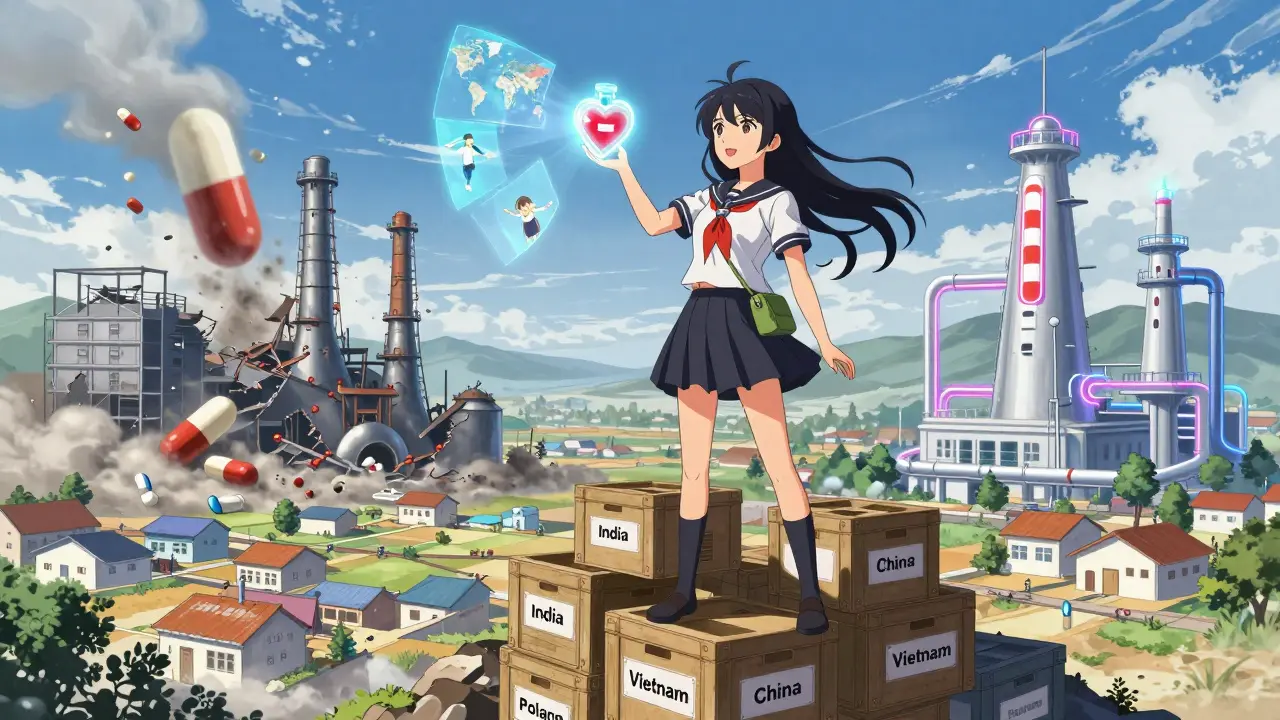
When COVID hit, many countries scrambled because their drug supplies were stuck in Chinese ports. That’s why countries like the U.S., India, and the EU are now investing in "reshoring" or "friendshoring" - building manufacturing capacity closer to home or in trusted allies.
India’s PLI scheme isn’t just about growth - it’s about reducing dependency. The EU is funding new API plants in Poland and Romania. The U.S. is offering grants to bring production back. This isn’t about nationalism. It’s about resilience. If you’re a generic drug maker relying on a single country for your raw materials, you’re playing Russian roulette with patient health.
Who’s winning - and who’s losing
The market is splitting into two camps.
On one side, the big players - companies like Teva, Sandoz, and Sun Pharma - are buying up biosimilar technology, investing in automation, and forming partnerships with local manufacturers in pharmerging markets. They’re not just selling pills anymore. They’re offering supply chain solutions, regulatory support, and even financing for clinics in rural India or Africa.
On the other side, small manufacturers are getting squeezed. Profit margins for generic drug makers have dropped from 18% in 2020 to 12% in 2024. Why? Because there are too many players chasing the same simple drugs. The FDA approved over 1,200 generic drugs in 2023 - and most of them were for the same 20-30 old medicines. When 10 companies make the same pill, the price crashes. And the smallest players can’t afford to keep up.
The winners will be those who move up the value chain: into biosimilars, into complex delivery systems (like injectables or inhalers), and into integrated healthcare services. The losers will be the factories still making 20-year-old pills with outdated equipment.
What comes next: 2025-2030
By 2030, the generic drug market will still be huge - but it won’t look like it does today.
- Biosimilars will grow 12.3% per year - outpacing traditional generics. Expect to see biosimilars for GLP-1 weight-loss drugs, cancer immunotherapies, and rare disease treatments.
- India and China will dominate manufacturing, but they’ll face more scrutiny. Expect stricter inspections, more audits, and mandatory quality certifications.
- Regulatory harmonization will accelerate. Countries without strong oversight will be forced to upgrade - or lose access to global markets.
- Supply chains will diversify. Expect new API hubs in Vietnam, Mexico, and Eastern Europe.
- Generic market share of total drug spending will drop from 57% in 2024 to around 53% by 2030. Why? Because biologics and specialty drugs are growing faster. But generics will still be the most used.
The future of generics isn’t about being the cheapest. It’s about being the most reliable, the most scalable, and the most innovative. The companies that survive won’t be the ones with the lowest prices. They’ll be the ones with the strongest systems - from quality control to supply chain to regulatory compliance.
Final thought: It’s not about drugs - it’s about access
At its core, the generic drug market exists for one reason: to make medicine affordable. No matter how complex biosimilars get, or how much regulation tightens, that mission doesn’t change. The next decade will test whether the system can deliver on that promise - without cutting corners, without relying on fragile supply chains, and without leaving behind the people who need it most.
If the world gets this right, billions will keep getting the drugs they need. If it gets it wrong, the cost won’t just be financial - it’ll be human.
I love how this post flips the script on generics. It’s not about cheap pills anymore-it’s about *systems*. The real story isn’t in the dosage, it’s in the supply chain. 65% of APIs from one country? That’s not globalization. That’s a single point of failure with a pharmacy label. And yet we keep acting like it’s sustainable. We’re not preparing for a pandemic. We’re preparing for a *pharmaceutical blackout*.
The biosimilar transition is fascinating-but let’s be honest: most of these 'innovations' are just regulatory arbitrage with fancy lab coats. The real value isn’t in the science-it’s in the lobbying. Companies are spending $250M to develop a biosimilar… then pricing it 20% below the original. That’s not competition. That’s a cartel with a GMP certificate.
India produces 60,000+ generics and 20% of global volume-and now you want us to be scrutinized like a criminal lab? We feed the world. We don’t cut corners-we cut costs. You think your $5 insulin is cheap because of your FDA? It’s cheap because Indian engineers worked 18-hour days in factories with no AC. Don’t lecture us on quality when your country outsourced its entire pharmaceutical backbone.
I appreciate the nuance here. It’s easy to villainize manufacturers, but the real villain is the system that rewards volume over value. If we want safe, affordable drugs, we need to pay for them properly. You can’t have a $10 pill and expect $100M quality control. We need to restructure incentives-not just regulate.
This is so important!! 💯 I’ve been reading up on this for months and honestly? The biosimilar shift is the quiet revolution no one’s talking about. Also-can we just appreciate how wild it is that India and China are basically the lungs of global pharma? 🤯
The FDA’s 187 warning letters in 2023? That’s not a crisis-it’s a feature. It means oversight is working. The problem isn’t foreign manufacturers-it’s that the U.S. and EU have outsourced production while retaining regulatory authority. That’s not efficiency. It’s liability laundering. We need to stop pretending we’re not complicit.
You speak of biosimilars as if they’re the future-but have you considered the human cost? In rural India, a man works 12 hours a day in a factory making vials of insulin that will be shipped to Kenya. He earns $3 a day. His child has asthma. He can’t afford the inhaler. The system doesn’t care about access. It cares about margins. And when your ‘scalable innovation’ leaves behind the people who made it possible-you’re not a hero. You’re a parasite.
Let’s not pretend this is about healthcare. It’s about geopolitics. China controls the APIs. India controls the pills. The U.S. controls the patents. The EU controls the regulations. And the rest of the world? They’re just patients with credit cards. This isn’t a market. It’s a colonial supply chain with a white coat.
Reshoring? Friendshoring? Please. You think moving API production to Poland is going to fix anything? The cost of labor, energy, and compliance in the West is 5x higher. That’s not resilience. That’s a taxpayer-funded subsidy for pharma CEOs to keep their bonuses. We’re not fixing the system-we’re just making it more expensive for the poor.
I’ve been following this for years. I’ve seen the videos. The rat-infested labs. The falsified data. The expired ingredients shipped as ‘fresh.’ And the FDA? They’re just one agency. They can’t inspect 78 different systems. What if the next pandemic isn’t a virus? What if it’s a batch of contaminated blood pressure meds? Who’s going to tell the families? You think they’ll get a letter from the WHO? No. They’ll get a funeral bill.
There’s a deeper truth here we’re avoiding: the generic drug market is the last vestige of medicine as a public good. Everything else-biologics, gene therapy, AI-driven diagnostics-is becoming a luxury. Generics are the last line of defense against healthcare becoming a gated community. If we let this system collapse, we’re not just losing access to pills. We’re losing the idea that life-saving medicine should be a right-not a transaction.
I’m British. I’ve seen the NHS rely on Indian generics for decades. We don’t have a choice. But here’s the irony: we’re now funding UK-based drug manufacturing… while our own regulators refuse to certify the very factories we’ve depended on for 20 years. Hypocrisy isn’t a policy. It’s a disease.