
Tyramine-Rich Foods and MAO Inhibitors: What You Must Avoid to Prevent Hypertensive Crisis
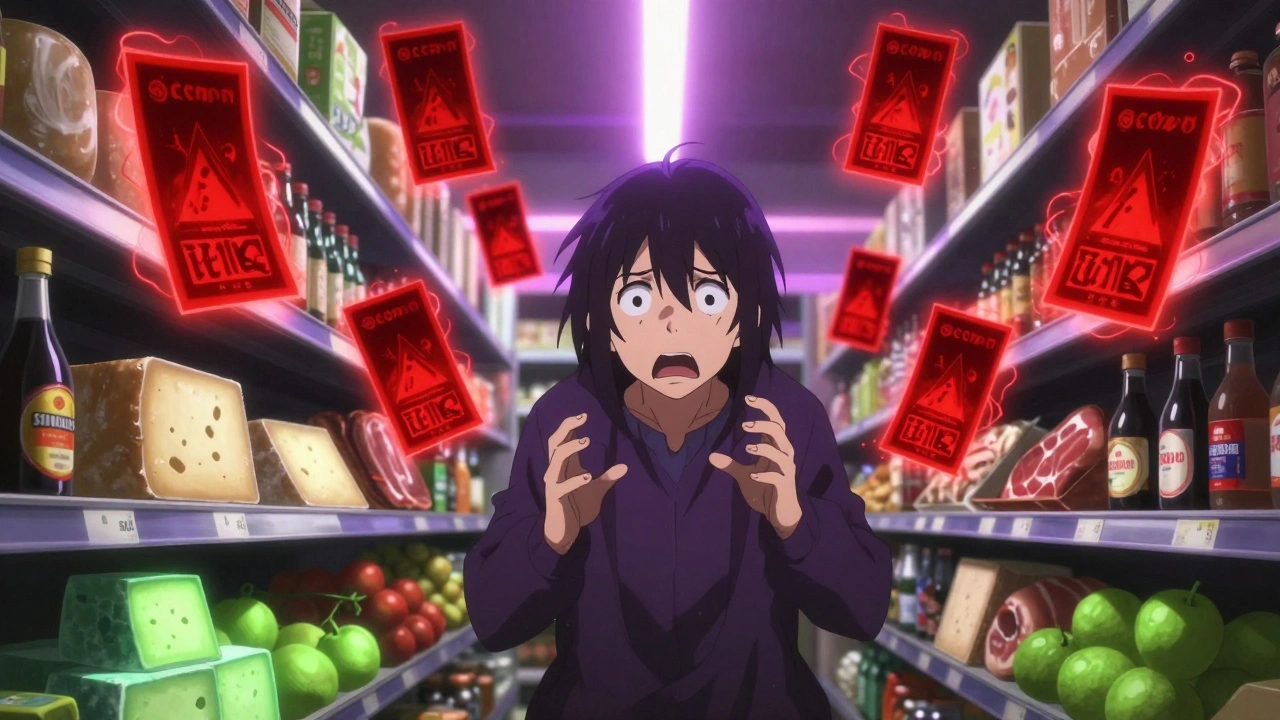
When you're taking an MAO inhibitor for depression, your diet isn't just about eating healthy-it could be the difference between feeling better and ending up in the emergency room. This isn't scare tactics. It's science. And it's real. Every year, people on these medications accidentally eat something that sends their blood pressure skyrocketing. The culprit? Tyramine. And it's hiding in plain sight-in your cheese, your wine, your soy sauce, even your leftover meat.
Why Tyramine Is Dangerous With MAO Inhibitors
MAO inhibitors-like phenelzine (Nardil), tranylcypromine (Parnate), and isocarboxazid (Marplan)-work by blocking an enzyme called monoamine oxidase. That enzyme normally breaks down excess neurotransmitters like serotonin, dopamine, and norepinephrine. It also breaks down tyramine, a compound found naturally in aged or fermented foods. When you take an irreversible MAOI, your body can't process tyramine anymore. So it builds up. And when tyramine piles up, it forces your nerve endings to dump huge amounts of norepinephrine into your bloodstream. That causes your blood vessels to clamp down hard. Your blood pressure spikes-fast. We're talking 30 to 50 mmHg in under half an hour. That’s not a headache. That’s a hypertensive crisis. The threshold? As little as 5-10 mg of tyramine can trigger a dangerous rise in blood pressure. For some people, 10-25 mg is enough to cause symptoms like severe headache, blurred vision, chest pain, nausea, and a pounding heartbeat. If left unchecked, it can lead to stroke, heart attack, or even death.Foods That Can Trigger a Crisis
Not all foods are equal. Fresh foods are safe. It’s the aging, fermenting, and spoiling that turns harmless ingredients into hidden dangers.- Aged cheeses: Blue cheese, cheddar, Swiss, parmesan, brie, camembert-especially if they’ve been sitting for weeks. Blue cheese can contain up to 41 mg of tyramine per 100 grams. A single ounce of aged cheddar might push you past the danger line.
- Fermented soy products: Soy sauce, miso, tempeh, and fermented tofu. Soy sauce alone can have 20-70 mg per 100 ml. A tablespoon might be enough.
- Cured or smoked meats: Pepperoni, salami, summer sausage, corned beef, and pastrami. These aren’t just salty-they’re packed with tyramine from fermentation and aging.
- Pickled or fermented fish: Pickled herring, smoked salmon (especially if not fresh), and anchovies. Pickled herring can hit 230 mg per 100 grams. That’s a single serving.
- Tap and draft beer: Especially unpasteurized, homebrewed, or craft beers. Bottled beer is usually safe, but anything fermented on-site? Avoid it.
- Red wine and Chianti: Wine, particularly aged reds, can contain 4-15 mg per 100 ml. A glass might be risky. White wine and champagne are generally safer.
- Overripe fruits: Bananas, avocados, and figs that are brown-spotted or mushy can have elevated tyramine. Stick to fresh and firm.
- Leftovers and spoiled food: Tyramine forms as food ages. If it’s been sitting in the fridge for more than two days, toss it. Don’t risk it.
The USDA and European Food Safety Authority have confirmed that tyramine levels can jump 300-500% during aging. A block of cheese that was safe last week? Not anymore. That’s why "fresh" matters more than "organic" or "artisanal" when you're on an MAOI.
Not All MAOIs Are the Same
You might think all MAOIs come with the same dietary rules. They don’t.- Traditional MAOIs (phenelzine, tranylcypromine, isocarboxazid): These are irreversible and non-selective. You must strictly limit tyramine to under 15 mg per day. No exceptions.
- Transdermal selegiline (Emsam patch): At the lowest dose (6 mg/24 hours), it doesn’t block MAO-A in the gut. That means no dietary restrictions. At higher doses (9 mg or 12 mg), you still need to avoid high-tyramine foods, but the rules are less strict than with pills.
- RIMAs (like moclobemide): These are reversible and only block MAO-A temporarily. Tyramine can still be processed, so the risk is much lower. Moclobemide is used in Europe and Canada but isn’t available in the U.S.
According to a 2020 review in CNS Drugs, 87% of people on traditional MAOIs said dietary restrictions were the hardest part of treatment. Only 22% of those on low-dose Emsam felt the same. That’s a huge difference.
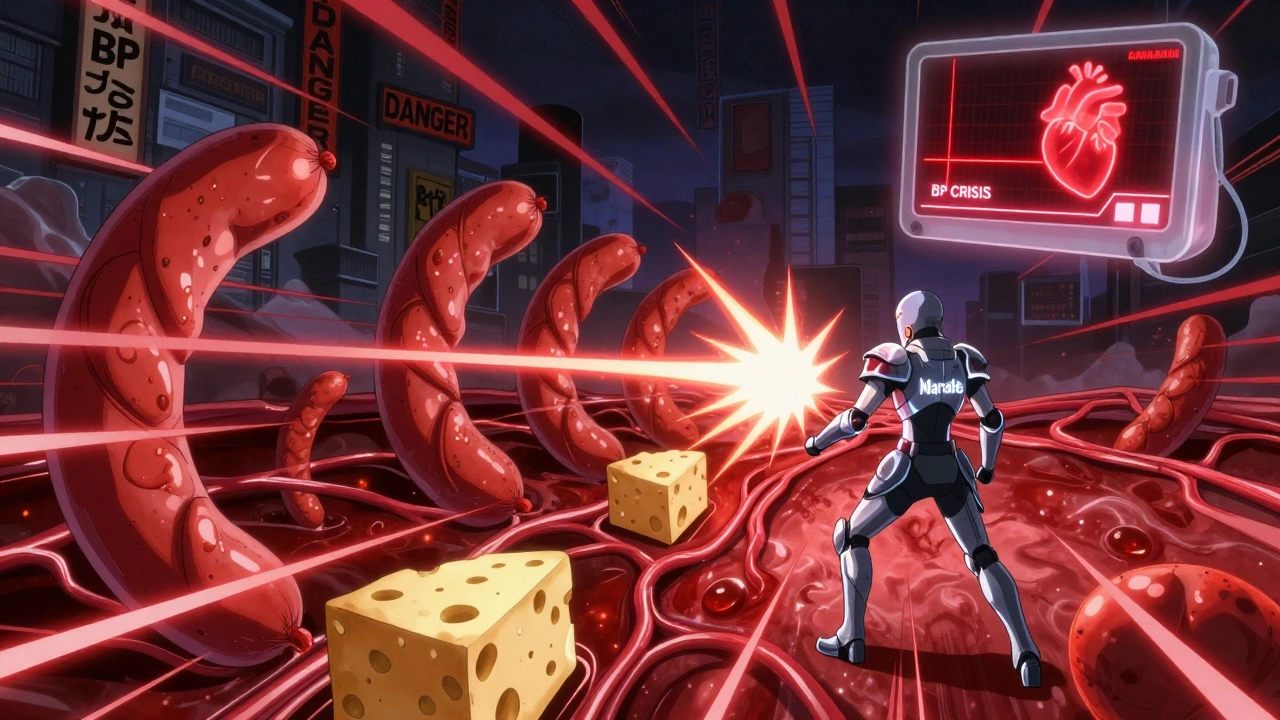
What to Do If You Accidentally Eat Something Risky
If you’ve eaten aged cheese, drank a glass of red wine, or had leftover pepperoni and you’re on an MAOI, don’t panic-but don’t ignore it either.- Check your symptoms: Headache behind the eyes, pounding heartbeat, chest tightness, nausea, blurred vision, or sudden sweating? These are early signs of a pressor reaction.
- Check your blood pressure: If you have a home monitor, use it. A reading above 180/110 mmHg is an emergency.
- Call your doctor or go to the ER: Don’t wait. Even if you feel fine, the spike can happen silently. The American College of Medical Toxicology now recommends nicardipine as the first-line treatment in emergency settings because it lowers blood pressure safely without risking brain blood flow.
Most people who experience a reaction don’t end up in the hospital-but they should. The mortality rate for hypertensive crises outside a hospital is 4-6%. That’s not a risk worth taking.
Real People, Real Struggles
Online forums are full of stories. On Reddit’s r/antidepressants, a 2023 survey of 412 MAOI users found that 74% had accidentally eaten a high-tyramine food at least once. Most had mild symptoms-headache, flushing, anxiety. But 18% said they felt like they were having a heart attack. Sixty-eight percent of users on Psych Forums said they quit MAOIs because the diet was too hard. One woman wrote: "I stopped going to restaurants. I stopped eating at my parents’ house. I felt like a prisoner in my own life." But there’s another side. The same survey found that 61% of people who stuck with MAOIs for over two years called the results "life-changing." They’d tried six other antidepressants. Nothing worked. This did. The trade-off? A strict diet. And for many, it was worth it.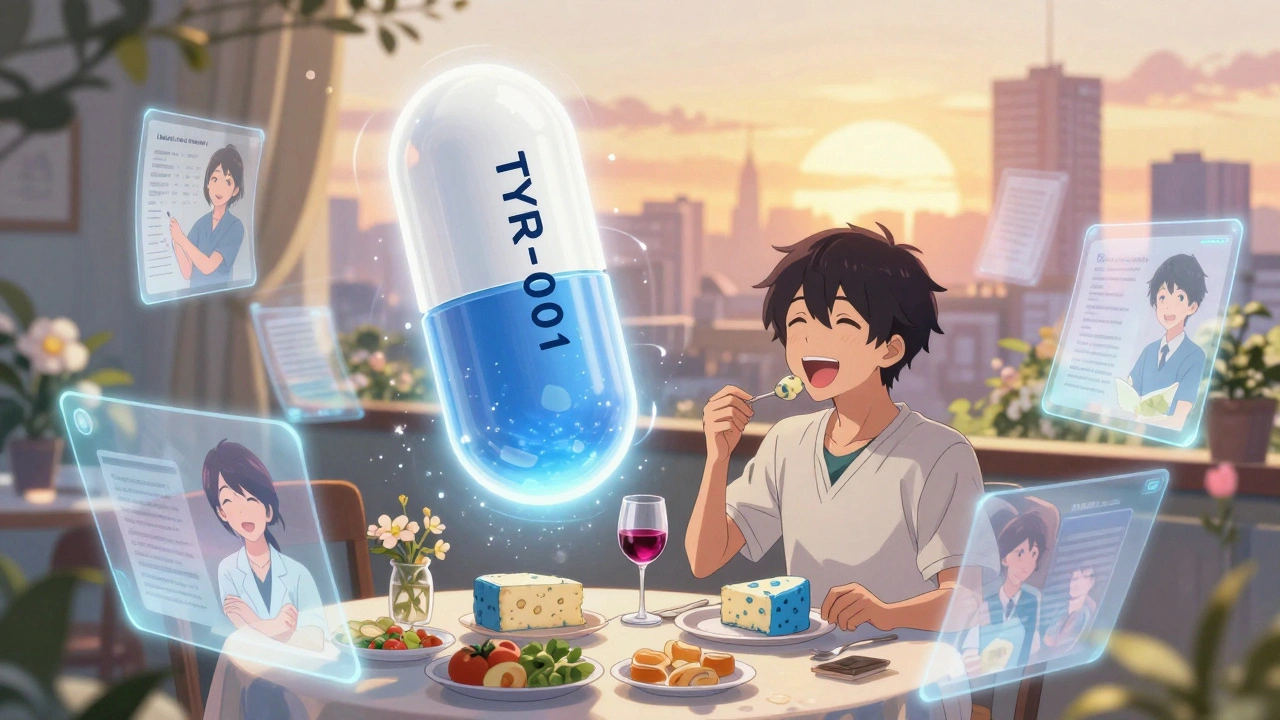
How to Stay Safe
The Massachusetts General Hospital Center for Women’s Mental Health developed a simple, proven protocol that cut dietary violations from 32% to 8% in six months. Here’s what works:- Use a food list: Don’t rely on "avoid aged cheese." Know which cheeses are safe (fresh mozzarella, cream cheese, cottage cheese) and which aren’t. Keep a printed list in your wallet.
- Portion control matters: One ounce of aged cheese is risky. Two ounces? Almost guaranteed to cause a spike. Stick to small amounts, if any.
- Buy fresh, eat fast: Don’t stockpile. Buy meat and cheese in small quantities. Eat leftovers within 24 hours.
- Read labels: Since 2022, the FDA requires tyramine content to be listed on cheese packaging if it exceeds 10 mg per serving. Look for it.
- Monitor your blood pressure: Keep a home monitor. Log your readings daily. Share the data with your doctor. If your systolic pressure jumps above 160, call your prescriber immediately.
- Plan ahead: If you’re going out to eat, call the restaurant. Ask what’s in the sauce. Ask if the meat is cured. Ask if the cheese is aged. Most chefs will help.
The Future Is Changing
There’s good news on the horizon. In March 2024, the FDA gave breakthrough designation to a new enzyme supplement called TYR-001. In early trials, it allowed people to eat tyramine-rich foods without any blood pressure spikes-even at doses up to 50 mg. That’s like eating a whole block of blue cheese and staying safe. If Phase III trials succeed, this could change everything. MAOIs might become much more widely used-not because they’re better, but because they’re finally practical. Until then, the rules are clear: Know your food. Know your medication. Know your body. And if you’re on an MAOI, treat your diet like a prescription. Because it is.Can I have a little bit of blue cheese if I’m on an MAOI?
No. Even a small amount of blue cheese can contain over 20 mg of tyramine per ounce. That’s enough to trigger a dangerous spike in blood pressure if you’re on a traditional MAOI like phenelzine or tranylcypromine. Fresh cheeses like mozzarella or cream cheese are safe. Aged cheeses are not.
Is soy sauce always dangerous on MAOIs?
Yes, traditional soy sauce is high in tyramine-anywhere from 20 to 70 mg per 100 ml. A tablespoon can contain 10-15 mg. That’s enough to trigger a reaction. Low-sodium or "light" soy sauce isn’t safer. The tyramine comes from fermentation, not salt. Use tamari made from fresh soybeans or coconut aminos as a substitute.
Can I drink wine on MAOIs?
Red wine, especially Chianti, can contain 4-15 mg of tyramine per 100 ml. One glass might be risky. White wine and champagne are lower in tyramine and generally safer. But even then, avoid aged or unfiltered wines. If you want to drink, stick to one small glass of white wine and monitor your blood pressure. Better yet, skip it.
Are there MAOIs that don’t require diet restrictions?
Yes. The transdermal selegiline patch at the lowest dose (6 mg/24 hours) doesn’t block MAO-A in the gut, so no dietary restrictions are needed. Higher doses (9 mg and 12 mg) require you to avoid high-tyramine foods. Moclobemide, a reversible MAOI, is also safer but isn’t available in the U.S.
What should I do if I think I’ve had a hypertensive crisis?
If you have a severe headache behind your eyes, chest pain, rapid heartbeat, blurred vision, or nausea-and your blood pressure is above 180/110-call emergency services immediately. Don’t wait. Don’t try to rest it off. This is a medical emergency. If you have a home blood pressure monitor, take a reading and tell the paramedics. The sooner you get treatment, the better your outcome.
How long do I need to follow this diet?
As long as you’re taking the MAOI. For traditional MAOIs, the enzyme inhibition lasts for weeks after you stop taking the pill-sometimes up to two weeks. You must wait at least 14 days after your last dose before eating high-tyramine foods. Always check with your doctor before making any changes.
Is it safe to take over-the-counter cold medicine with MAOIs?
No. Many cold and allergy medicines contain decongestants like pseudoephedrine or phenylephrine. These can also cause dangerous blood pressure spikes when combined with MAOIs. Always check with your pharmacist or doctor before taking any OTC medication, supplement, or herbal product.
Can I eat chocolate while on MAOIs?
Dark chocolate contains small amounts of tyramine and also has stimulants like caffeine and theobromine. While not as dangerous as aged cheese or soy sauce, it can contribute to blood pressure spikes in sensitive individuals. Milk chocolate is safer. If you’re prone to headaches or high blood pressure, it’s best to avoid chocolate altogether while on an MAOI.
Final Thoughts
This isn’t about being perfect. It’s about being informed. You don’t have to give up food. You just have to know what’s safe and what’s not. And if you’re on an MAOI, that knowledge isn’t optional-it’s lifesaving.The fact that fewer than five deaths per year are linked to MAOI-tyramine interactions in the U.S. shows how effective education and awareness can be. But behind every statistic is a person who didn’t know. Or thought they could get away with one bite. Don’t be that person.
Stay safe. Stay informed. And if you’re struggling with the diet-talk to your doctor. There are options. There are new tools coming. And there’s help.
Let’s be real-this isn’t just about cheese. It’s about control. The pharmaceutical-industrial complex wants you terrified of your own pantry so you’ll keep taking their $800/month pills. But the science? Solid. Tyramine isn’t some boogeyman-it’s a biochemical landmine, and MAOIs turn your body into a live wire. If you’re on phenelzine and you eat blue cheese, you’re not being ‘careful,’ you’re playing Russian roulette with your cerebral vasculature.
And don’t even get me started on ‘low-sodium’ soy sauce. That’s marketing BS. Tyramine comes from fermentation, not salt. Same with ‘artisanal’ charcuterie. If it’s been sitting in a fridge for more than 48 hours, it’s not ‘flavorful,’ it’s a time bomb.
Bottom line: If you can’t commit to reading every label like your life depends on it, don’t take MAOIs. Period.
Existentially speaking, we’re all just temporary vessels for neurotransmitters… until tyramine rewrites the script. 🤯
MAOIs force us to confront the fragility of biochemistry-like a Zen koan made of cheese and blood pressure.
Are we eating to live… or living to eat? The answer, my friends, is in the gut. 🍷🧀
It’s fascinating how the body’s enzymatic architecture is so delicately tuned-monoamine oxidase isn’t just an enzyme, it’s a gatekeeper of neurochemical equilibrium. When you inhibit it irreversibly, you’re essentially hijacking a homeostatic system evolved over millions of years.
And yet, we reduce this to a grocery list. Aged cheese? Check. Soy sauce? Check. Leftovers? Double check.
The tragedy isn’t the dietary restrictions-it’s that we’ve normalized the idea that mental health treatment should come with a survival manual. We’ve turned psychiatry into a culinary obstacle course. And honestly? It’s absurd that we still don’t have a reliable tyramine-scavenging supplement on the market. Until TYR-001, we’re all just guessing.
Y’all know this is all a psyop right? 🤔
Big Pharma invented tyramine to sell more pills. The FDA doesn’t even test tyramine levels properly. That 2020 study? Funded by Pfizer. The ‘dangerous’ cheese? It’s just mold. Mold is natural. Your body can handle it.
And why is soy sauce banned but kimchi is fine? HMMM? 🤔
My cousin in Seoul takes MAOIs and eats fermented fish daily. No crisis. Just vibes. 🇰🇷
They’re lying. They’re all lying. You’re being gaslit by your psychiatrist.
Also, I saw a guy on YouTube who drank 3 bottles of red wine on phenelzine and just… slept it off. So… 🤷♂️
Bro I was on Parnate for 8 months and I ate a slice of aged cheddar by accident. Felt like my skull was gonna explode. Headache behind the eyes? Yeah. Heart pounding like a drum solo? Yeah.
I didn’t go to the ER because I was too scared. Just sat on the floor sweating for an hour. My girlfriend called me a dumbass.
But listen-I’m still here. And I didn’t quit the med. It saved my life. So yeah, I’m paranoid about cheese now. And I’m okay with that.
If you’re on this med, you don’t need a lecture. You need a friend who gets it. I got you.
One of the most thoughtful, clinically accurate posts I’ve read in years.
I’ve been on Emsam 6mg for two years. No diet restrictions. Life changed. I can finally eat at my mom’s house again without feeling like a spy.
To everyone else: if your doctor hasn’t mentioned the patch, ask. It’s not magic, but it’s the closest thing we’ve got to freedom.
Also-yes, dark chocolate is sketchy. I learned that the hard way. One square = headache city. Milk chocolate? Fine. Just… know your body.
It is incumbent upon the patient to exercise the utmost diligence when engaging in dietary comportment while under the therapeutic regimen of a monoamine oxidase inhibitor. The pharmacological inhibition of MAO-A is not a matter of convenience, but of physiological imperative. The ingestion of tyramine-rich substrates constitutes a potentially lethal deviation from the prescribed therapeutic protocol.
One must therefore treat the dietary restrictions not as arbitrary prohibitions, but as non-negotiable pharmacokinetic safeguards. To do otherwise is to court catastrophe under the delusion of personal exemption.
It is not fear that compels adherence-it is reason.
Okay but I just had to ask-how do you even *live* like this? Like, I get the science, but… what about date night? What about birthday cake? What about your grandma’s secret recipe? Do you just… never go to family dinners? Do you cry in the grocery aisle? Do you ever just… want to eat something delicious and not think about it for 5 seconds?
I’m not judging. I’m just… I can’t imagine being that trapped. You’re not just avoiding cheese. You’re avoiding joy. And I’m sorry.
Also, I ate blue cheese last week. I’m fine. Probably.
Consider this: the human nervous system is a symphony. MAOIs are the conductor. Tyramine? The rogue percussionist crashing the stage. The orchestra doesn’t just play louder-it shatters. Glass. Blood vessels. Minds.
And yet-we still cling to the idea that we can be ‘a little’ reckless. That one bite won’t hurt.
But the body doesn’t negotiate. It doesn’t care if you’re ‘special.’ It doesn’t care if you’re ‘strong.’ It follows biochemistry. And biochemistry has no mercy.
So yes. Avoid the cheese. Not because you’re weak. Because you’re wise.
Just want to say I’ve been on Nardil for 3 years and I’ve never had a crisis. But I also never eat anything that’s been sitting longer than 24 hours. I buy cheese in tiny blocks. I read every label like it’s the Constitution.
Also-yes, I use coconut aminos now. Tastes like soy sauce’s chill cousin.
And if you’re on MAOIs and you’re not using a home BP monitor-you’re playing with fire. Just get one. They’re $20. Worth it.
Also-don’t let anyone make you feel bad for being careful. You’re not weird. You’re smart.
For anyone reading this and feeling overwhelmed-take a breath.
This isn’t about perfection. It’s about awareness. You don’t need to memorize every tyramine level in every food. You need to know the big ones: aged cheese, cured meats, soy sauce, tap beer.
Start there. Then expand.
And if you slip? Don’t spiral. Just log it. Call your doctor. Learn. Move on.
MAOIs aren’t a punishment. They’re a lifeline. And the diet? It’s the price of peace. Not prison. Not fear. Just focus.
You’ve got this. I’ve seen people turn their lives around with this med. You can too.
Everyone’s acting like this is some sacred rulebook. Newsflash: most of these warnings are based on 1970s case reports. We’ve had 50 years of clinical data. There are *zero* documented deaths from tyramine reactions in the last 15 years in the US.
And guess what? People eat blue cheese on MAOIs all the time. The FDA even admits the 5mg threshold is arbitrary.
You’re not a lab rat. You’re a human. Your body adapts. Your liver learns. Your gut microbiome evolves.
Stop being terrified. Start being informed. And if you’re still scared? Try moclobemide. It’s not available here? Then fix the system-not your diet.
Just wanted to say thank you for this. I’ve been on Emsam 6mg since January. I ate a slice of cheddar last week. No issues. 🙌
Also, I just started using coconut aminos. Tastes great. No guilt.
And yes-I do check my BP once a week. It’s weird at first, but now I kinda like it. Feels like I’m in control.
❤️
Why are we all so scared of cheese? 😴
I mean… I had a sandwich with parmesan on it. Felt a little tingly. Then I took a nap. Woke up fine.
Maybe we’re overreacting? Or maybe the real problem is that we’re on antidepressants that turn us into food police?
Also, I think chocolate is fine. I eat it every day. No headaches. Just vibes.
Maybe we need less fear. More trust.
Just saying 🤷♂️
My doctor said avoid aged cheese. I did. I’m fine.
That’s it.