
Pain Neuroscience Education: How Understanding Pain Can Change Your Experience
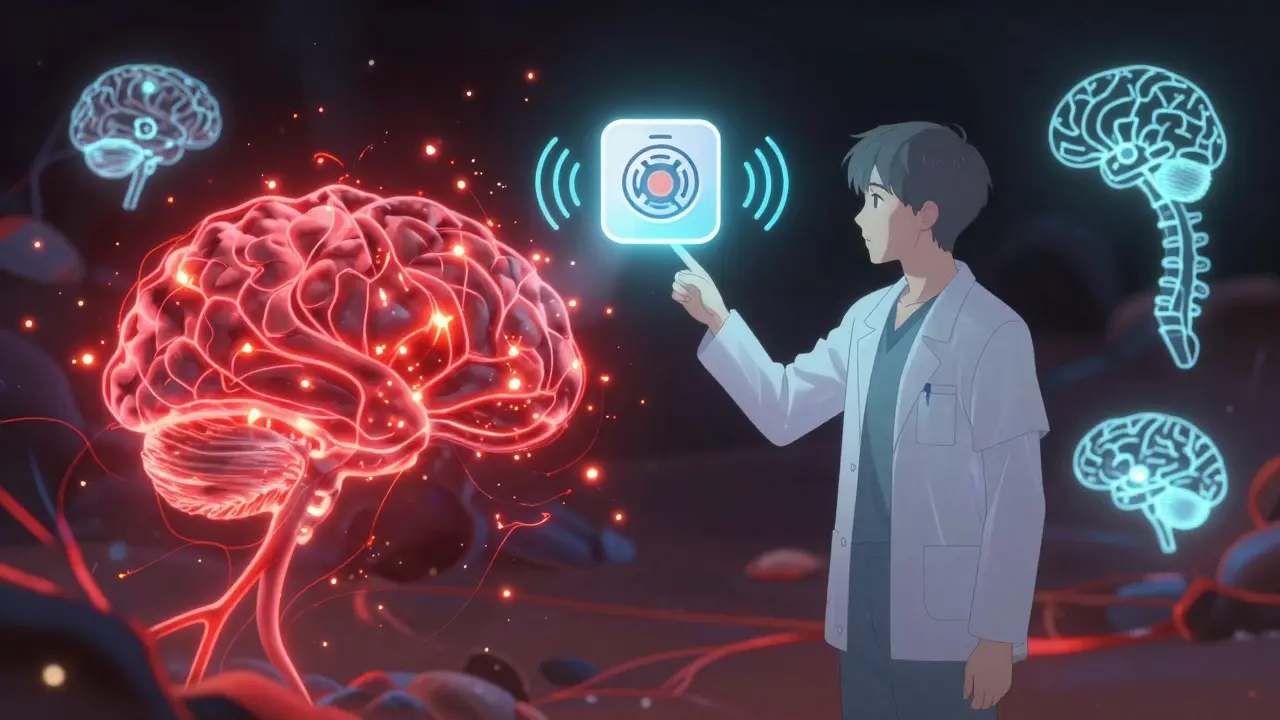
For years, people with chronic pain were told: "Your back is damaged. Your knee is worn out. That’s why it hurts." They got scans, pills, and sometimes surgery. But the pain stayed. Or got worse. Why? Because pain isn’t just a signal from damaged tissue. It’s a complex output from your brain - shaped by stress, fear, past experiences, and even how you think about your body. Pain Neuroscience Education flips that script. It doesn’t ignore your pain. It helps you understand it differently - and that changes everything.
What Pain Neuroscience Education Really Is
Pain Neuroscience Education, or PNE, isn’t a treatment like massage or exercise. It’s a conversation. A learning experience. It teaches people that pain is not a direct measurement of tissue damage. It’s your nervous system’s alarm system - and sometimes, that alarm gets too sensitive. Think of it like a smoke alarm that goes off every time you burn toast. The alarm isn’t broken. But it’s overreacting. That’s what happens in chronic pain. Your brain starts interpreting normal movements, pressure, or even stress as threats - and turns up the pain volume.
PNE explains this using simple metaphors, diagrams, and real-life examples. You learn about peripheral sensitization - when nerves near an injury become extra responsive. Central sensitization - when your spinal cord and brain become hypersensitive, amplifying pain signals. And neuroplasticity - the brain’s ability to rewire itself. This isn’t theory. It’s science backed by over 20 systematic reviews. Studies show that after PNE, people report less pain, less fear of movement, and better function - even if their MRI still shows "degenerative changes."
How PNE Works: From Fear to Freedom
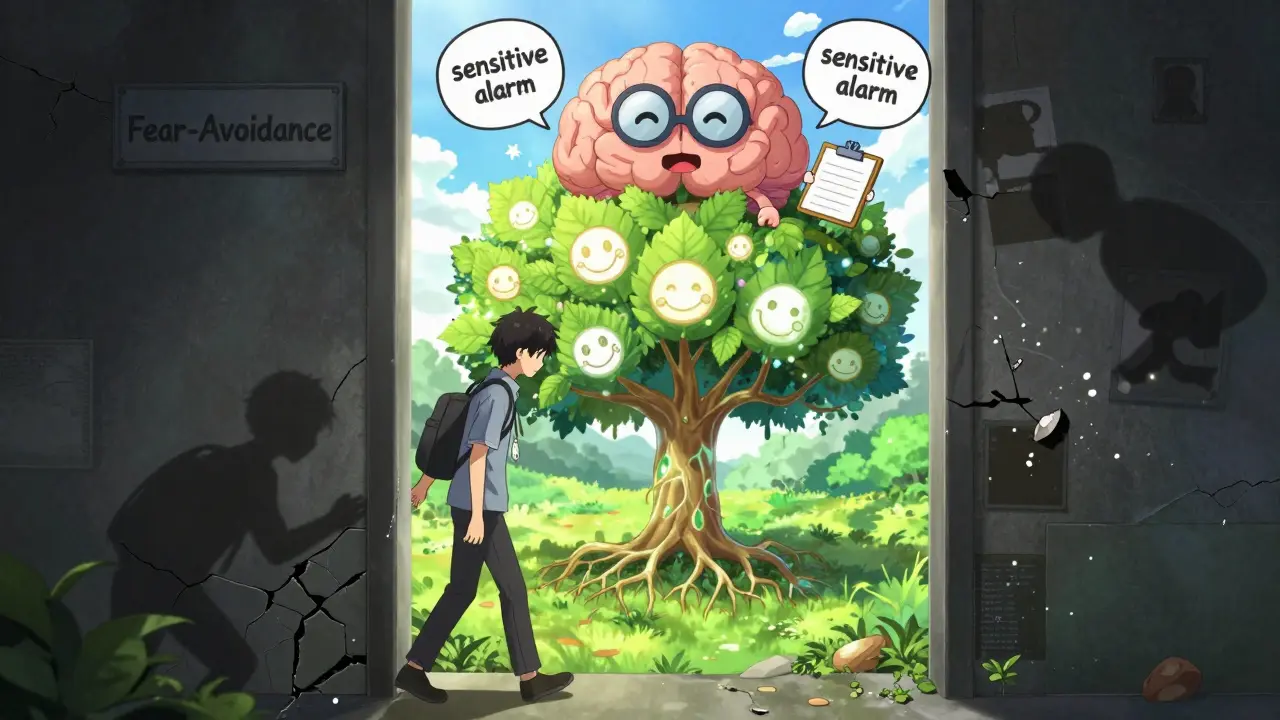
Most people with long-term pain develop fear-avoidance behaviors. They stop moving. They avoid lifting, bending, walking, or even laughing too hard. Why? Because they’ve been taught that pain = damage. So they protect themselves - and end up weaker, stiffer, and more sensitive. PNE breaks that cycle.
One common metaphor used in PNE is the "sensitive smoke alarm." Instead of thinking, "My back is broken," you learn: "My alarm is too sensitive. My body is safe, but my brain is being cautious." This simple shift reduces threat. And when the brain feels less threatened, it lowers pain output. fMRI studies show this isn’t just talk. After PNE, brain areas linked to threat processing - like the amygdala and insula - show reduced activity. The prefrontal cortex, which helps with rational thinking, becomes more active. Your brain literally learns to respond differently.
Real-world results? In a 2023 review of 23 trials, people who received PNE saw an average pain reduction of 1.8 points on a 10-point scale. Disability improved by 12.3%. Pain catastrophizing - that spiral of "This will never end," "I can’t handle this," or "Something’s terribly wrong" - dropped by over 6 points on a standard scale. That’s not minor. That’s life-changing.
Who Delivers PNE and How It’s Done
PNE is most often delivered by physical therapists, but occupational therapists, psychologists, and even some physicians use it too. It’s not a one-size-fits-all lecture. A good session lasts 30 to 45 minutes. It’s interactive. You ask questions. The clinician listens. They tailor the explanation to your background - whether you’re a nurse, a mechanic, or a retiree.
Two main approaches dominate: the "Explain Pain" model by David Butler and Lorimer Moseley, and Adriaan Louw’s "Therapeutic Neuroscience Education." Both use stories, drawings, and analogies. One patient I worked with was a 42-year-old nurse with fibromyalgia. She was taking six pain pills a day. After six sessions of PNE - combined with gentle movement - she cut her pills to one every three days. Not because her body changed. Because her understanding did.
Tools help. The "Explain Pain Handbook" is the most widely used resource. Digital apps like "Pain Revolution" have over 186,000 downloads. Some clinics use VR now to simulate how the nervous system works - patients can "see" pain signals firing and calming down. Written summaries are given to reinforce learning. The goal? Make the science stick.
What PNE Can and Can’t Do
PNE isn’t magic. It doesn’t erase pain overnight. It doesn’t fix structural problems like a torn ligament. But it changes how you relate to pain - and that’s powerful.
It works best for chronic pain: low back pain, fibromyalgia, complex regional pain syndrome, persistent neck pain. In studies, 82% of chronic pain patients benefit. For acute pain - like after surgery or a sprained ankle - it’s less effective. Only 11% of studies showed clear benefit. Why? Because in acute cases, tissue damage is real. The alarm is working as designed.
It’s also less effective for people with severe cognitive impairment or low health literacy. If someone can’t grasp abstract concepts like "neuroplasticity," the metaphors need to be simpler. Say "nervous system" instead of "central sensitization." Use "body alarm" instead of "neuromatrix." The core idea still works - you just speak their language.
And it won’t help if you expect it to make your pain disappear. Some patients drop out because they think PNE is a quick fix. It’s not. It’s a mindset shift. It takes time. And it works best when paired with movement - not instead of it.
Why PNE Beats Traditional Pain Education
Traditional pain education says: "Rest. Avoid activity. Don’t strain your back." It reinforces fear. PNE says: "Your body is safe. Movement is medicine. Pain doesn’t equal damage."
Here’s the data: In a 2022 review, PNE improved disability scores by 4.7 points on a standard questionnaire. Traditional education? Just 1.2 points. When PNE is added to regular physical therapy, pain drops by 10.8 points on a 100-point scale - compared to only 5.3 with therapy alone. That’s nearly double the benefit.
It also outperforms placebo education. One study gave people fake pain lessons - generic advice like "stay active." PNE beat it by 35% in reducing pain catastrophizing. Why? Because it’s not vague. It’s specific. It’s science made simple.
And it’s becoming standard. In 2023, 68% of U.S. physical therapy clinics specializing in pain use PNE. It’s taught in 72% of U.S. physical therapy programs - up from just 12% in 2010. Medicare now reimburses it under therapy codes. Fortune 100 companies use it to cut workers’ comp claims by 22%.

Getting Started with PNE
If you’re living with chronic pain and feel stuck, PNE might be the missing piece. You don’t need a referral. Many physical therapists offer it. Ask: "Do you use Pain Neuroscience Education?" If they say yes, ask how they explain pain. Do they use metaphors? Do they talk about the brain? Do they make you feel safe?
If you’re a clinician, start small. Learn the basics. Read the "Explain Pain Handbook." Watch videos by Lorimer Moseley or Adriaan Louw. Practice explaining pain as a protective output, not a damage signal. Don’t rush. It takes 3 to 6 months to feel confident. Use simple language. Avoid jargon. And remember: your goal isn’t to teach neuroscience. It’s to change how someone feels about their pain.
What Patients Say
On Reddit’s r/ChronicPain, a user named PainWarrior87 wrote: "After six months of fearing movement would damage my back, the metaphor of a sensitive smoke alarm helped me understand my pain wasn’t signaling danger. I’ve since returned to hiking and reduced opioid use by 75%." That’s not an outlier. It’s the pattern.
Some people say it’s "too much science." That’s true - if it’s delivered poorly. But when it’s clear, relatable, and kind? People feel seen. Understood. Empowered. One woman told me: "For the first time, I didn’t feel like my body was betraying me. I felt like I finally understood what was going on. And that made me brave enough to move again."
It’s not about fixing your spine. It’s about fixing your relationship with pain.
Is Pain Neuroscience Education the same as cognitive behavioral therapy (CBT)?
No. CBT focuses on changing thoughts and behaviors around pain - like challenging negative thinking patterns. PNE focuses on changing your understanding of pain itself - teaching you how your nervous system works. They’re different tools. But they work well together. Some clinics combine them. PNE gives you the science. CBT helps you apply it to daily life.
Can PNE help if I’ve had pain for over 10 years?
Yes - and often, the longer you’ve had pain, the more benefit you’ll see. Chronic pain changes your nervous system. PNE helps reverse that. Studies show people with 10+ years of pain still improve significantly in pain intensity, function, and emotional well-being after PNE. Your brain can relearn safety - no matter how long you’ve been in pain.
Do I need an MRI or X-ray before starting PNE?
No. PNE works regardless of imaging results. Many people with severe pain have "normal" scans. Many with "degenerative" scans feel no pain. PNE teaches you that scans don’t tell the full story. Your pain is real - but it’s not always caused by what the scan shows. Focusing too much on imaging can actually make pain worse by reinforcing fear.
How many PNE sessions do I need?
Most people benefit from 3 to 6 sessions, each lasting 30-45 minutes. The first session introduces the core concepts. Later sessions build on them, connect them to your daily life, and reinforce learning. Some people get it in one session. Others need more. It depends on your background, how long you’ve had pain, and how open you are to new ideas.
Will PNE make my pain go away completely?
Not always - but it often makes it much more manageable. The goal isn’t zero pain. It’s reducing fear, increasing function, and reclaiming your life. Many people still feel some pain, but they no longer panic when it shows up. They move more, sleep better, and stop avoiding life. That’s success. Pain can be a quiet background noise instead of a screaming alarm.
Is PNE covered by insurance?
Yes - in the U.S., Medicare and many private insurers cover PNE when delivered by licensed physical therapists under CPT codes 97160-97164. It’s billed as part of a physical therapy evaluation or management session. Check with your provider, but if your therapist offers PNE and you have therapy benefits, it’s likely covered.
What to Do Next
If you’re living with persistent pain and feel trapped by the idea that your body is broken, PNE might be your next step. Don’t wait for another scan, another pill, or another surgery. Ask your therapist: "Can you help me understand why my pain keeps happening?" If they say no, find someone who does. There are certified practitioners across the country. Online resources like the "Explain Pain" website or the Pain Revolution app can help you start learning now.
And if you’re a clinician - start today. You don’t need to be a neuroscientist. You just need to be curious. Ask your patients: "What do you think is causing your pain?" Listen. Then gently offer a new story. One that’s grounded in science. One that gives them power. Because the most effective treatment isn’t always the one that changes the body. Sometimes, it’s the one that changes the mind.
bro this is just cbt with extra steps. they slap a fancy neuroscience label on it and charge you $200/hour. i had chronic back pain for 8 years and all i needed was to stop being a wimp and move more. science my ass.
PNE is the only thing that actually helped me after 12 years of meds and PT. the smoke alarm metaphor changed my life. i dont fear movement anymore. i lift weights now. my pain is still there but its just noise not a siren
The reduction in pain catastrophizing scores is statistically significant but clinically negligible. The placebo effect dominates in chronic pain interventions. One must question the epistemological validity of neuroplasticity as a therapeutic target when the underlying pathophysiology remains unaddressed.
lol another western scam. in india we just take turmeric and yoga. no need for fancy brain lectures. your pain is your karma
they say pne works but i still hurt. why am i paying for this? my insurance says yes but my body says no. i think they just want to sell more books
This literally saved me 😭 I was about to quit my job because i was scared to bend over. Now i can play with my kids again. Thank you for sharing this 🙏
I'm from the Philippines and we don't have access to this kind of care but i read the explain pain handbook online. It made me feel less alone. Pain isn't weakness leaving the body. It's your body trying to protect you. 💛
I used to think my pain was a personal failure. Now i realize my nervous system was just being overly protective. That shift didn't make the pain vanish... but it made me stop hating my body. That's worth more than any pill.
PNE is just a marketing gimmick for physical therapists who can't do real rehab. they dont want to work with you they want to lecture you. i got better when i stopped listening to experts and started listening to my body
The 2023 review of 23 trials shows consistent effect sizes across diverse populations. This isn't anecdotal. The mechanism is neurophysiological not psychological. The data supports PNE as an evidence based intervention not a fad
PNE works because it makes you feel smart. You think you understand your pain so you feel in control. But real healing? That comes from movement. Not metaphors. 🤷♂️