
Out-of-Pocket Costs: How Generics Slash Your Medication Bills
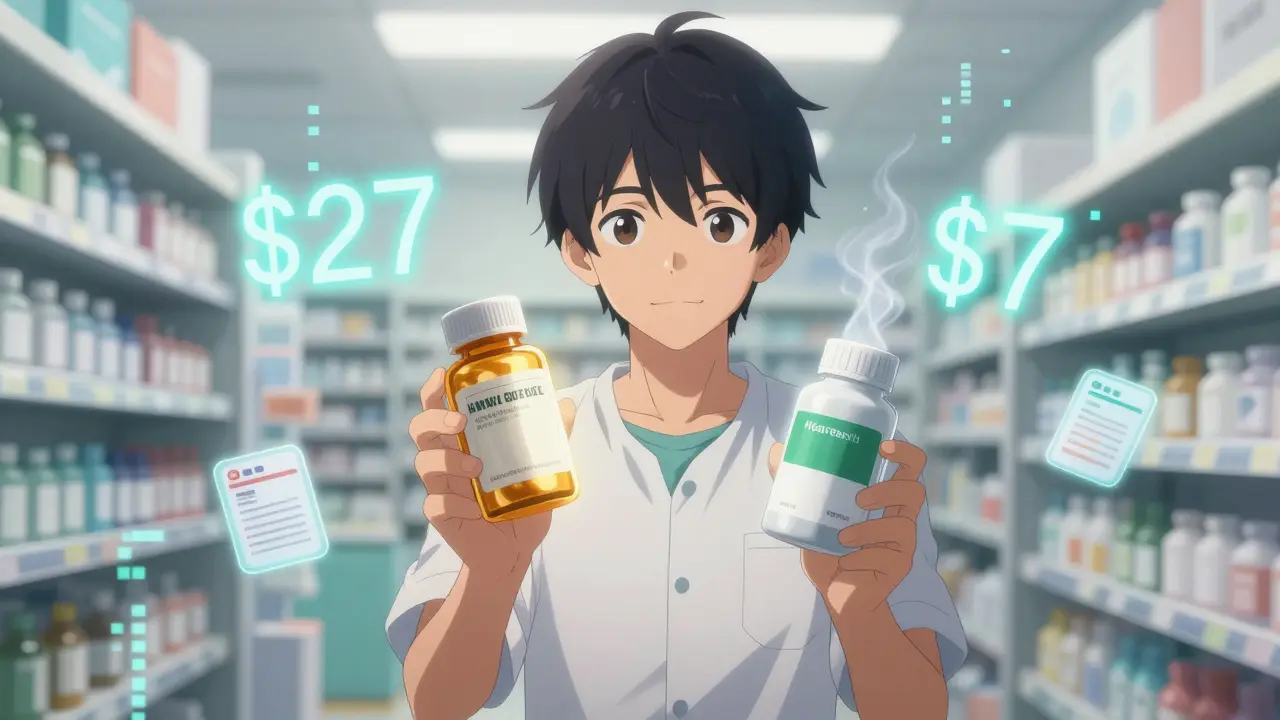
Imagine filling a prescription for a medication you need every day. You hand over your insurance card, wait a few minutes, and the pharmacist hands you a small bottle. The total? $27. That’s what many people pay for a brand-name drug. Now imagine the same pill, same active ingredient, same effectiveness - but it costs you $7. That’s not a dream. That’s what happens when you choose a generic drug.
What Exactly Is a Generic Drug?
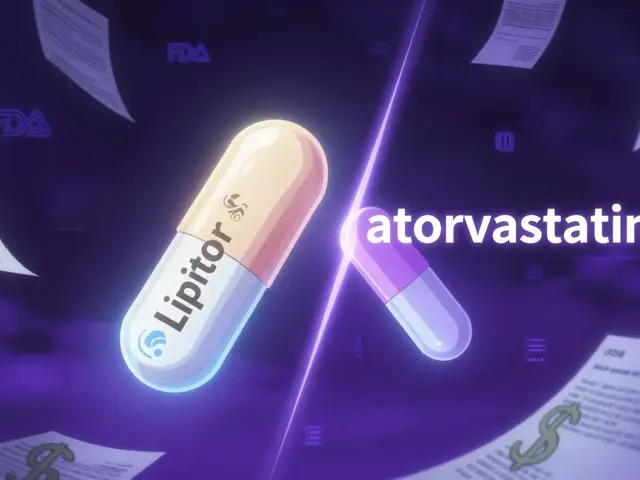
A generic drug is the exact same medicine as the brand-name version, just without the marketing budget. It has the same active ingredient, same dosage, same way it works in your body. The FDA requires generics to meet the same strict standards as brand-name drugs. They’re not cheaper because they’re lower quality - they’re cheaper because the company didn’t spend millions on ads, fancy packaging, or patent lawsuits.
By 2023, 90% of all prescriptions filled in the U.S. were for generics. Yet these same generics made up only 13.1% of total drug spending. That’s the power of competition. Once a brand-name drug’s patent expires, other manufacturers can step in and sell the same medicine at a fraction of the cost. And they do - often by 80% to 95%.
The Real Cost Difference: Brand vs Generic
Let’s break it down with real numbers. In 2023, the average out-of-pocket cost for a generic prescription was $7.05. For a brand-name drug? $27.10. That’s almost four times more. Some cases are even starker:
- Sildenafil Citrate (Viagra) dropped from $49.90 to $3.07 per pill after generics hit the market - a 94% drop.
- Emtricitabine/Tenofovir (Truvada) fell from $20.46 to $2.13 - a 90% savings.
- Efavirenz, emtricitabine, and tenofovir tablets went from around $1,000 for a 30-day supply to just $65.
These aren’t rare exceptions. They’re the norm. Over 93% of all generic prescriptions cost $20 or less. More than 82% cost under $20. Even if you’re paying cash - no insurance - you’re still likely paying under $50 for a month’s supply of most generics.
Why Do People Still Pay More Than They Should?
If generics are so cheap, why do so many people end up paying $20, $30, or even $50 for them? The answer isn’t about the drugs - it’s about the system.
Insurance plans often treat generics like luxury items. Instead of putting them in the lowest-cost tier, some plans put them in higher tiers with bigger copays. One study found that when insurers moved generics to higher tiers, patients ended up paying 135% more annually - even as drug prices fell overall.
Then there’s the pharmacy markup. A 2023 NIH study found that if you buy generics from a direct-to-consumer online pharmacy, you save an average of 75% compared to walking into a retail pharmacy like Walgreens or CVS. For example:
- Pantoprazole 20mg: $9.20 from an online pharmacy vs $44 at Albertsons - 79% savings.
- Rosuvastatin 5mg: $7.50 from Health Warehouse vs $110 at Walgreens - 93% savings.
Same pills. Same manufacturer. Different prices - because of how the supply chain is set up. Insurance companies, pharmacy benefit managers (PBMs), and retail chains all take cuts. The patient ends up paying the difference.

Medicare Part D Is Overpaying - And You’re Paying For It
Even people with Medicare Part D aren’t safe. In 2018, Medicare spent $2.6 billion more than it needed to on prescriptions - mostly because it paid more than Costco charged. For 90-day fills, Medicare overspent by 29.4%. That’s not a typo. People with insurance paid more than people who walked into Costco and bought the same generic without insurance.
Why? Because Medicare’s pricing system is tied to list prices, not actual market prices. PBMs negotiate rebates behind closed doors, and those savings don’t always reach the patient. So even when a generic costs $5 at Costco, your insurance might still charge you $25 because that’s what the system says it’s worth.
Generics Are Saving Billions - But Not Everyone Benefits
Over the past decade, generic and biosimilar drugs saved the U.S. healthcare system $445 billion. That’s enough to cover free prescriptions for millions of people. But the savings aren’t evenly distributed. While the system as a whole pays less, many patients still pay more than they should.
Here’s the irony: people pay a higher share of the cost for generics (41.8%) than for brand-name drugs (32.1%). Why? Because insurance plans assume generics are cheap enough that patients can afford to pay more. That logic backfires. When you’re living paycheck to paycheck, $7 is still too much if you’re choosing between medicine and groceries.

What Can You Do to Save Money?
You don’t have to accept high out-of-pocket costs. Here’s what works:
- Ask for the generic - every time. Even if your doctor writes the brand name, the pharmacist can substitute unless the doctor says “dispense as written.”
- Compare prices - use apps like GoodRx, SingleCare, or RxSaver. They show real-time prices at nearby pharmacies and online options.
- Buy from online pharmacies - for stable, long-term medications, DTC pharmacies like HealthWarehouse or MCCPDC often offer the lowest prices. Many are licensed and FDA-compliant.
- Check your plan’s formulary - if your generic is in a high tier, call your insurer. Ask if there’s a lower-cost alternative or if you can get a prior authorization to switch tiers.
- Ask about 90-day supplies - many plans offer lower copays for 90-day fills. But make sure you’re comparing the total cost, not just the per-month price.
The Bigger Picture: Why This Still Isn’t Fixed
The problem isn’t that generics don’t work - they work too well. They’ve forced brand-name companies to compete on price. But the middlemen - PBMs, insurers, and retail chains - have adapted by creating complex pricing games that shift costs onto patients.
When a generic drops from $100 to $5, the manufacturer doesn’t get richer. The middlemen do. They keep the difference between what the pharmacy pays and what the patient pays. That’s why the same pill can cost $7 at one pharmacy and $110 at another.
Real reform means transparency. Patients should know what the drug actually costs before they pay. Insurance plans should pass savings directly to customers - not use them to pad profits. And pharmacies should be required to show the true cash price upfront, not just the inflated insurance rate.
Until then, you’re not powerless. You have more control over your medication costs than you think. Generics are the tool. Knowledge is your leverage. Use both.
This is such a crock. Generics are just the pharma companies' way of funneling more profit to the middlemen while pretending they care about patients. You think $7 is cheap? Try living on $1200 a month and see how fast that $7 adds up when you're on five different meds. The system is rigged and you're just a number to them.
Bro, generics are the unsung heroes of pharmacoeconomics! The cost elasticity curve for branded vs generic is a textbook case of market efficiency-PBM-induced price asymmetry is a classic case of regulatory capture. The real villain? The opaque rebate ecosystem that distorts the supply chain like a broken Fourier transform. We need transparent pricing APIs, stat!
Thanks for sharing this. I’ve been taking generic metformin for 8 years now-same as the brand, same results, but I pay $3 instead of $50. It’s not just about money, it’s about dignity. 🙏 If you’re scared to switch, ask your pharmacist-they’re usually the real MVPs in this whole mess. We’re all in this together.
While the data presented is statistically significant, it’s fundamentally reductionist. The implicit assumption that cost equals value ignores the epistemological hierarchy of pharmaceutical innovation. One might argue that the $27 price tag isn’t for the pill-it’s for the decades of R&D, clinical trials, and regulatory compliance that preceded it. To equate generics with equity is to misunderstand the very architecture of medical progress.
Let me tell you something about this whole generics thing. I used to work in a pharmacy in Manchester and I saw it all. People come in, ask for the generic, get it, then come back three days later because they think it’s ‘not working’-but it’s the same damn molecule. Then they blame the doctor, the pharmacist, the government. Meanwhile, they’re still buying the brand because they think it’s ‘better’-like it’s some kind of luxury perfume. It’s pathetic. And don’t even get me started on GoodRx-those apps are just glorified price gouging fronts for big pharma. They don’t care if you save $20, they just want you to keep clicking ads. The system is designed to keep you confused and compliant.
Wow so generics are cheap now? Who knew? I guess all those people who died because their insurance wouldn’t cover the brand name just didn’t know to ask for the $7 version. Oh wait they did. And the pharmacist said ‘sorry, your doctor wrote brand only’ and the doctor was too busy to change it because the EHR system won’t let them unless you fill out 17 forms. But sure, it’s all on the patient. 🙄
This article is a joke. You think people don’t know generics exist? They do. But when your insurance forces you to try three generics before covering the one that actually works for your condition, and then denies coverage anyway because ‘it’s not medically necessary’-you don’t get to pat yourself on the back for saving $7. This isn’t empowerment. It’s cruelty dressed up as finance.
Same pill. Different price. Same as my landlord raising rent but calling it ‘maintenance fee’. 🤡
It is imperative to note that the United States Department of Health and Human Services has established rigorous bioequivalence standards for generic pharmaceuticals. Any assertion that these medications are inferior is scientifically unfounded and potentially dangerous. Patients must be educated to recognize that cost does not equate to quality in regulated pharmaceutical markets.
Y’all this is literally life-changing info 😭 I just switched my blood pressure med to generic through GoodRx and saved $90 this month. I cried. I bought myself a coffee. I felt human again. Thank you for sharing this. We need more people talking about this. 💙
Let’s not romanticize generics. This is a neoliberal fantasy. The fact that we’re celebrating $7 pills instead of demanding universal coverage reveals the depth of our ideological decay. You think a pill is the solution? No. The solution is a healthcare system that doesn’t treat medicine like a commodity. But hey, at least we can feel good about our $7 savings while the system burns.
i just found out my insulin generic is 30 bucks at walmart and i’ve been paying 120 for years… i feel so dumb. i never checked. thanks for this. i’m gonna go change my script today
One must consider the ethical weight of pharmaceutical pricing. If a life-saving drug can be manufactured for pennies, yet sold for hundreds, is it not a moral failure of the entire system? Generics are a band-aid. True justice would be pricing based on need, not profit. But we live in a world where market logic overrides human dignity. We are not consumers. We are patients.
Knowledge is power. Always ask for the generic. Always compare prices. Always advocate for yourself. Your health is worth the effort. No excuses. No compromises. Take control.