
Shin Splints and Stress Fractures: Evidence-Based Return-to-Run Plans
Running hurts. Not the good kind of hurt - the kind that means you’re pushing your limits. The kind that says, shin splints or worse, a stress fracture, is creeping up on you. You’ve been logging miles, feeling strong, then one day your shin screams every time your foot hits the ground. You try to tough it out. You ice it. You stretch. You take a few days off. But when you try to run again, it’s back. And now you’re stuck: you don’t know if it’s just soreness or something serious. And if it is serious, how do you get back to running without blowing it up again?
Here’s the truth: most runners don’t recover properly from shin pain. They either rest too long and lose fitness, or they rush back and end up with a full stress fracture - or worse, a recurrence. The difference between a quick return and a long, frustrating setback isn’t luck. It’s a structured plan. And it’s not one-size-fits-all.
Shin Splints vs. Stress Fractures: What’s the Real Difference?
Shin splints - or medial tibial stress syndrome (MTSS) - are an inflammation of the tissue around your shinbone. It’s diffuse pain along the inner edge of your tibia, usually worse at the start of a run, then eases up as you warm up. It’s common. About 1 in 5 running injuries is MTSS.
A stress fracture is a tiny crack in the bone itself. This isn’t just soreness. It’s bone fatigue. The pain is sharp, localized, and gets worse with activity. Press on the spot? It hurts. Walk barefoot on tile? It hurts. Rest doesn’t fix it - it just stops it from getting worse.
Here’s the key: MTSS usually improves with 1-2 weeks of reduced loading. A stress fracture? That needs 6-12 weeks of bone healing before you even think about running again. Mistaking a stress fracture for shin splints is the #1 reason runners re-injure themselves. If your pain is pinpoint and doesn’t fade after a few days off, get an MRI. No guesswork.
The 6-Phase Return-to-Run Protocol (Backed by Science)
Forget the old advice: “Take two weeks off, then start slow.” That’s not enough. Modern rehab is broken into phases - each with clear rules. Skip a phase? You risk failure. Rush it? You’ll be back in the clinic.
Phase 1: Pain-Free Walking
Start here if you can’t walk without pain. No running. No jumping. No stair climbing. Focus on walking pain-free for at least 7 straight days. This isn’t optional. Bone needs to calm down. If you’re still hurting after 10 days, see a physio. This phase can take 3-10 days for MTSS, but 4-6 weeks for a stress fracture.
Phase 2: Gentle Loading
Once walking is pain-free, start loading the bone gently. Do double-leg heel raises: 3 sets of 15-20 reps, once a day. Stand on the floor, rise onto your toes, lower slowly. Keep the movement controlled. No bouncing. If you feel any pain above a 2/10, stop. This phase lasts 7-14 days.
Phase 3: Full Range Strength
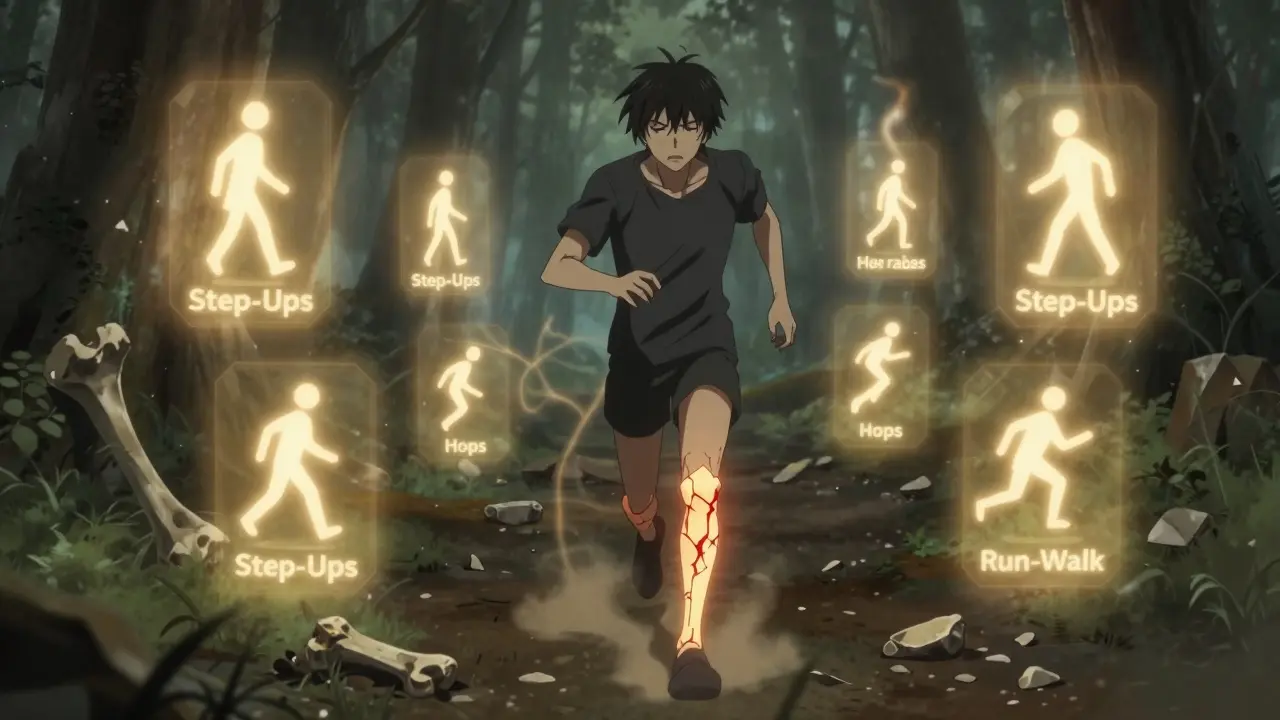
Now add step-ups. Stand on a low step (5-10 cm), rise onto your toes, then lower your heel below the step. Do 3 sets of 10-15 reps. This increases the stretch on your calf and tibia, building resilience. Do this daily. If your pain stays under 2/10, move on. If it flares, go back to heel raises.
Phase 4: Explosive Strength
Time for plyos. Start with double-leg hops - 2 sets of 10-15, every other day. Land softly. No pain. Then, after 2 weeks, move to single-leg hops. Still no pain. If you feel anything sharp, stop. This phase builds the shock absorption your bone needs for running. It’s not about height - it’s about control.
Phase 5: Run-Walk Progression
This is where most runners mess up. Don’t jump into a 5K. Start with a 1:4 run-walk ratio. Run 1 minute, walk 4 minutes. Repeat for 20 minutes total. Do this 3 times a week. Only if you’re pain-free for 7 days straight. Then, week 3: 1:3 ratio for 25 minutes. Week 4: 1:2 for 30 minutes. Week 5: 1:1 for 35 minutes. Week 6: 3:1 for 40 minutes. That’s it. That’s the protocol for low-risk stress injuries (posterior medial tibia). High-risk sites like the front of the shin or femoral neck? Double the time.
Phase 6: Return to Full Running
Once you’re running 40 minutes at a 3:1 ratio with no pain, you’re ready to increase mileage. But don’t go back to your old routine. Stick to a 10% weekly increase - but only if you’re pain-free. And here’s the twist: research shows 68% of runners can’t handle even 10% increases because their bones haven’t adapted. So listen to your body. If your shin feels tight after a run, take a rest day. Don’t push.
Why the 10% Rule Doesn’t Work for Everyone
You’ve heard it: “Never increase your mileage by more than 10% per week.” Sounds smart. But it’s outdated. A 2024 review in Sports Medicine found that 68% of runners with stress fractures got injured because they followed this rule blindly. Why? Bone doesn’t adapt on a calendar. It adapts on load, nutrition, sleep, and hormones.
Two female runners, same age, same mileage increase - one gets a stress fracture, the other doesn’t. Why? One has low iron, the other doesn’t. One has low vitamin D, the other’s levels are fine. One is under-fueled - she’s not eating enough to cover her training. That’s Relative Energy Deficiency in Sport (RED-S). It’s behind 31% of recurrent stress fractures in women, according to the IOC.
So the real rule isn’t 10%. It’s: “If it hurts, stop. If you’re tired, rest. If you’re hungry, eat.”

The Hidden Culprits: Hip Weakness and Poor Gait
Shin pain isn’t just about your shins. It’s about your hips, your core, your foot strike. Studies show 57% of runners who skip hip-strengthening exercises re-injure themselves within 3 months. Weak glutes mean your leg rotates inward when you land - that pulls on your tibia. Do clamshells, side leg raises, and single-leg bridges 3 times a week. Even after you’re running again.
And gait? Most runners overstride - landing with their foot far in front of their hip. That creates a braking force that sends shock up the shin. Dr. Casey Kerrigan’s research found gait retraining reduces tibial strain by 38%. Heel lifts? Only 12-15%. That’s why physiotherapists now use video analysis. If you’re serious about staying injury-free, get your stride checked.
What You Can Do Right Now
Here’s your action list:
- If you’re in pain: Stop running. Walk pain-free for 7 days.
- Get an MRI if pain is sharp, localized, or doesn’t improve in 10 days.
- Start heel raises - 3x15-20 reps daily - once walking is pain-free.
- Do hip exercises 3x a week: clamshells, side leg raises, bridges.
- Track pain on a 0-10 scale every day. No pain above 2/10 during rehab.
- Never increase running time or intensity on back-to-back days.
- Check your nutrition: protein, calcium, vitamin D, iron. If you’re a woman and your period is irregular, get tested for RED-S.
What Doesn’t Work (And Why)
Shin sleeves? They might feel good, but they don’t heal bone. Ice? Reduces swelling, doesn’t fix the cause. Foam rolling your shins? Can make it worse - you’re pressing on inflamed tissue, not fixing the load issue.
And don’t trust “quick fix” apps that say, “Run 5K in 6 weeks!” If you’re rehabbing a stress injury, that’s a recipe for disaster. Real recovery takes time. And patience.

When to See a Pro
Go to a physio who specializes in runners if:
- Pain lasts more than 2 weeks with rest
- You’ve had this injury before
- You’re a female runner with irregular periods
- You’re not improving despite following a plan
Specialists use tools like 3D motion capture and bone density scans (DXA). They’ll check your training load, nutrition, and biomechanics - not just your shin. In the U.S., 87% of insurance plans now cover 12 physio sessions for this. Use them.
Technology Is Helping - But It’s Not a Replacement
Wearable tech like WHOOP and Garmin now track “bone strain” using heart rate variability and movement patterns. Apps like RunRx use AI to predict recovery time based on your training history and blood markers. Some elite teams use AlterG anti-gravity treadmills to run at 40% body weight while healing.
But tech doesn’t replace judgment. A machine can’t tell if you’re eating enough. It can’t tell if you’re sleeping poorly. It can’t tell if you’re stressed out. The best tool you have? Your own body - and the discipline to listen to it.
The Bottom Line
Shin splints and stress fractures aren’t just “running injuries.” They’re signals. Your body is telling you something’s off - load, fuel, form, or rest. The path back to running isn’t about how fast you can go. It’s about how smart you can be.
Follow the phases. Respect the pain scale. Strengthen your hips. Eat like an athlete. And don’t rush. The runners who come back stronger aren’t the ones who trained the hardest during recovery. They’re the ones who waited.
Can I still cross-train while recovering from shin splints or a stress fracture?
Yes - and you should. Pool running, cycling, and elliptical training maintain cardiovascular fitness without loading your shins. Avoid high-impact activities like jumping or stair climbing. Pool running is especially effective - it mimics running form with zero ground impact. Aim for 3-4 sessions per week, 30-45 minutes each.
How long does it take to return to running after a stress fracture?
It depends on the location and severity. Low-risk stress fractures (like the back of the shin) usually take 6 weeks before running can begin. High-risk sites - such as the front of the shin, navicular bone, or femoral neck - require 8 to 12 weeks. You must be pain-free at rest, during walking, and during rehab exercises before starting any running. Rushing this stage increases recurrence risk by up to 32%.
Is it safe to run through mild shin pain?
No. Pain is your body’s warning system. A pain level above 2/10 during activity is a red flag. If the pain is sharp, localized, or worse in the morning, it’s likely a stress fracture - not just shin splints. Running through pain can turn a minor stress reaction into a full fracture, adding months to your recovery. Stop. Assess. Get help.
Why do some runners keep re-injuring the same shin?
The most common reason is incomplete rehab. Many runners return to running too soon, skip hip and core strengthening, or ignore nutrition. Another major cause is undiagnosed RED-S - low energy availability affecting hormones and bone density. Up to 31% of female runners with recurrent stress fractures have this condition. Blood tests for iron, vitamin D, and hormones are critical for anyone with repeat injuries.
Do compression sleeves or orthotics help with shin splints?
Compression sleeves may reduce discomfort temporarily, but they don’t fix the root cause. Orthotics can help if you have flat feet or overpronation, but studies show they’re only effective in about 30% of cases. The real fix is strengthening your calf, hip, and foot muscles, and correcting your running form. Don’t rely on gear - build resilience in your body.
Can I prevent shin splints and stress fractures from coming back?
Yes. After recovery, maintain strength work 2-3 times per week, especially for your glutes and calves. Gradually increase mileage - no more than 10% per week, and only if you feel zero pain. Get your running form analyzed every 6-12 months. Eat enough calories to match your training. And listen to your body. If your shins feel tight after a run, take a rest day. Prevention isn’t about running more - it’s about running smarter.
This is the most useful running injury guide I've ever read. No fluff, just facts. Saved it for my next rehab phase.
I had a stress fracture last year and skipped phase 2 because I was bored. Big mistake. Took me 4 months to get back. This protocol is legit. Just did heel raises today and my shin actually feels better. Thanks for laying this out.
Ugh another 'follow this 6 phase plan' post. I've seen 20 of these. The real issue? Most runners are just lazy and don't want to do the strength work. Stop blaming your shins and start lifting. Done.
I love this but typo in phase 5: '3:1 ratio for 40 minutes' should be '40 min' not '40 minutes' right? Also, did anyone try the AlterG treadmill? I'm curious if it's worth the cost or just hype.
Let’s be honest-this is the kind of content that makes me want to scream. You think a ‘10% rule’ is outdated? Darling, the real problem is that half of you are eating granola bars and calling it ‘fuel.’ You’re not athletes-you’re snackers with laces. Fix your diet before you fix your gait. And no, compression sleeves won’t save you from your own poor choices.
I don't trust any of this. I read somewhere that the government and Nike are in cahoots to keep runners injured so we buy more shoes and physio sessions. They don't want us running free. They want us dependent. My cousin in India ran barefoot on gravel for 10 years and never had shin pain. Why? Because he didn't buy into this corporate rehab scam. The real cure? Stop listening to white-coated gurus and go back to the earth. Also, my period's been off for 8 months and I'm still running. So maybe RED-S is just a myth invented by pharma.
The clinical precision of this protocol is commendable. However, one must consider the biomechanical variance among populations. Not all tibial stress responses are homogenous.
While the structure is methodical, I find the casual tone beneath the professional veneer somewhat unbecoming of a medical advisory. The use of phrases like ‘eat like an athlete’ and ‘don’t rush’ lacks the gravitas expected in clinical literature.
This is the kind of post that makes me want to hug someone. Seriously. So many runners feel alone in this pain, and you just gave them a roadmap with heart. I’ve been through this twice-once with a stress fracture, once with a full-blown meltdown because I ignored the 2/10 rule. You’re right. It’s not about how fast you get back. It’s about how wisely you get back. Keep sharing this. Someone out there needs to read it today.